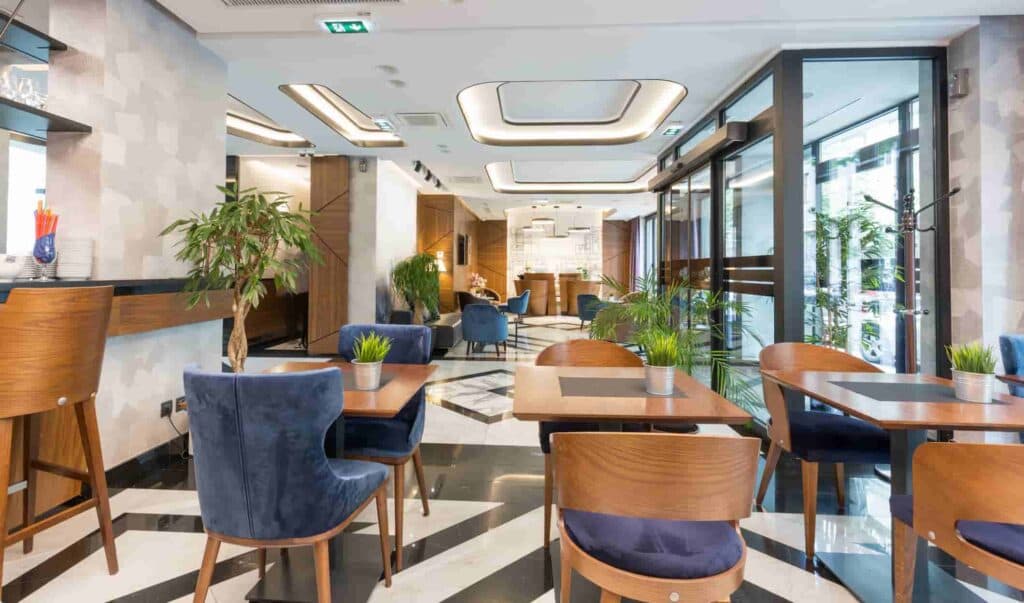
When planning a hospitality investment, restaurant seating layout Ghana plays a critical role in determining how efficiently your space operates and how much revenue you can generate per square meter. Many hotel and restaurant projects in Ghana fail to optimize their layout, leading to lost seating capacity and inefficient service flow.
A well-designed seating layout is not just about placing tables—it directly affects guest comfort, staff efficiency, and profitability. Especially in hotel projects, where restaurants serve multiple functions, layout planning must be approached strategically from the beginning.
Before planning your layout, reviewing a complete restaurant furniture Ghana guide helps you understand overall project requirements.
Restaurant seating capacity typically ranges between 0.6 and 1 seat per square meter, depending on the concept. Fine dining requires more space per guest, while casual dining layouts can achieve higher seating density with efficient table arrangements.
In Ghana, restaurant spaces must handle diverse usage:
This means your layout must be flexible, not static.
A poor layout creates:
A well-planned restaurant seating layout Ghana improves both operational efficiency and guest experience.
This performance also depends on selecting the right restaurant furniture materials ghana, as material durability and maintenance directly impact how efficiently the layout performs over time.
One of the most important metrics in layout planning is seats per square meter.
If your restaurant area is 120 m²:
That difference directly impacts revenue. Your seating layout decisions directly affect budget, so understanding restaurant furniture cost Ghana is critical during early planning.
Even small improvements in seating layout can increase total revenue by 10–20% without expanding the physical space, making layout planning one of the most critical decisions in hospitality projects.
Different layouts serve different operational goals.
For hotel projects in Ghana, a hybrid layout is usually the best approach.
Spacing is critical for both comfort and service efficiency.
Ignoring spacing leads to overcrowding and negative guest experiences.
In many restaurant projects, poor circulation planning reduces service speed more than kitchen capacity limitations, directly affecting customer satisfaction and table turnover.
Table size directly impacts how many guests you can serve. Choosing the right production source is important, and this restaurant furniture Ghana vs Turkey vs China comparison explains key differences.
Hotels in Ghana benefit from modular tables that can be combined.
Poor table selection reduces flexibility and limits layout efficiency.
Following the correct restaurant table measurement standards is essential to ensure optimal seating density, efficient circulation, and long-term layout flexibility.
Chair selection also affects layout efficiency.
From spacing to circulation, many layout decisions are directly affected by the selection of restaurant chairs ghana in hospitality environments.
Key considerations:
Using oversized chairs reduces total capacity significantly.
Hotel restaurants require more complex layouts.
If your restaurant is part of a larger development, this restaurant furniture for hotel projects Ghana guide provides deeper insights.
Outdoor dining is very common in Ghana hotel projects, which makes selecting the right outdoor restaurant furniture Ghana essential for both comfort and long-term durability.
Avoid these frequent errors:
These mistakes reduce efficiency and increase operational stress.
ç
Interior designers and contractors play a key role in layout success. Working with a professional restaurant furniture supplier for Ghana projects ensures your layout is both functional and scalable.
Best practices:
A well-coordinated team ensures that your restaurant seating layout Ghana performs efficiently after opening.
Seating layout is directly tied to profitability.
Key factors:
Even a 10% increase in seating capacity can significantly improve revenue over time.
In many hotel restaurants, layout efficiency directly influences up to 30% of total revenue performance, making seating design a key financial factor.Restaurant seating layout Ghana planning is frequently treated as a space planning exercise — how many tables fit, how wide the aisles are, how the zones divide. The constraint that most layout plans underestimate is furniture dimensions: the actual physical footprint of the tables and chairs specified for the project. A layout plan drawn with 750mm round tables and 450mm-wide chairs produces a different seating count than the same plan drawn with 800mm round tables and 520mm-wide chairs — and the difference is not recoverable after furniture is delivered.
Table overhang is the most common dimensional miscalculation in restaurant layout planning. A 750mm round table has a 750mm top diameter — but the base spreads to a pedestal or cross-base that extends 400 to 500mm, and chairs pulled out for seating extend a further 400 to 500mm beyond the table edge. The occupied footprint of a 750mm table with four chairs pulled out is approximately 1.8 to 2.0m in diameter — more than double the table top dimension. A layout plan that spaces table centres at 1.5m will produce chair-to-chair clearance below 300mm between adjacent tables, which is inadequate for comfortable dining and creates server circulation problems at peak service.
Chair stack height matters for layout planning in a different way — it determines how many chairs can be stored without a dedicated storage room. A restaurant that cannot store its chairs in a corner of the space during event configurations or cleaning periods needs a storage solution that takes floor area. If the layout plan does not account for chair storage, the storage problem gets resolved by leaving chairs in the dining area — reducing the operational flexibility that the layout was designed to provide.
The correct sequence for restaurant seating layout planning in Ghana hotel projects is: finalise furniture dimensions first, then draw the layout from those dimensions. Most layout errors occur because the sequence is reversed — the layout is drawn first, and furniture is then selected to fit it. When furniture dimensions change during procurement (a different table base, a wider chair), the layout plan is not updated, and the discrepancy becomes visible only during installation. For the standard table dimensions that should be used as inputs to layout planning before furniture is specified, see the restaurant table size standard guide. For the full range of restaurant table configurations including round, square, and rectangular options at standard hotel dimensions, see the restaurant table manufacturer page.
Hotel restaurants in Ghana serve multiple functions across a single day — breakfast buffet service, à la carte lunch, set-menu dinner, and occasionally private events or meeting room overflow. Each function has different seating density requirements, different circulation patterns, and different furniture configuration needs. A layout designed to optimise one function at the expense of the others produces a restaurant that performs well at its primary service period and creates operational friction at every other.
The solution is a reconfigurable layout — a furniture selection and placement strategy that allows the same floor area to be used efficiently for different service types with minimal reconfiguration effort. Reconfigurable layouts require furniture that supports reconfiguration: tables with folding or stackable legs, chairs that stack to a manageable height for in-room storage, and a base layout of fixed anchor pieces (booths, banquettes, bar) around which flexible table groupings can be rearranged.
Buffet service configuration requires the most floor area — not because buffet seating density is lower, but because buffet stations themselves occupy significant floor area and their positioning determines how guest traffic flows through the dining room. A buffet station placed against a wall creates a single-direction flow that produces queuing bottlenecks at peak service. A freestanding island buffet station creates a two-direction flow that reduces queue length but requires wider circulation aisles around the station. The buffet station position must be fixed before the seating layout is drawn — a buffet station added to a completed layout plan displaces seating and disrupts circulation patterns that were designed without it.
Private dining and event configurations require a different table grouping logic from daily service. Long banquet tables for group dinners, U-shape configurations for business meetings, and theatre-style rows for presentations all require table dimensions and chair types that support these configurations. A restaurant specified only for standard dining service cannot efficiently reconfigure for event use without acquiring additional furniture — which then needs storage space that was not planned for. According to Hospitality Net’s analysis of hotel restaurant design, multi-function spaces that are planned for reconfigurability from the beginning consistently achieve higher F&B revenue per square metre than single-function restaurant designs.
The relationship between seating layout planning and furniture procurement runs in both directions — layout decisions determine which furniture must be ordered, and furniture availability determines which layout configurations are achievable. In Ghana hotel projects where furniture is imported from Turkey on a 14 to 18 week procurement timeline, this interdependence creates a planning constraint that projects with local furniture supply do not face: layout decisions must be final before the production order is placed, because changing table dimensions or chair types after production has begun requires either accepting a compromise or adding 6 to 8 weeks to the production timeline.
The BOQ (Bill of Quantities) for restaurant furniture cannot be written accurately without a finalised layout plan. The layout plan determines the table count, table type mix (2-top, 4-top, 6-top), chair count, and any custom-dimension pieces required for booths or banquettes. A BOQ written before the layout is finalised produces an order that either over-specifies (tables and chairs that do not fit the final layout) or under-specifies (gaps discovered at installation). Both outcomes have been the source of procurement problems in Ghana hotel projects — over-specification wastes budget and creates surplus furniture that needs storage, while under-specification requires an additional order that arrives 14 to 18 weeks after the hotel has already opened.
The practical implication is a defined sequence: finalise the layout plan, write the furniture BOQ from the layout dimensions and counts, approach manufacturers with a complete BOQ, and lock the production order before any layout changes are made. Changes to the layout after the production order is placed must be evaluated against the production timeline — changes to quantities can often be accommodated within the first two weeks of production, but changes to dimensions require new technical drawings and restart the sample approval clock. For how the complete procurement timeline from layout finalisation to furniture on site works in a Ghana hotel project, see the hotel furniture lead time guide. For the full restaurant seating product range including chairs, bar stools, and booth seating, see the restaurant and café furniture manufacturer page.
Successful restaurant layouts balance:
When these elements are aligned, your restaurant becomes a high-performing revenue center within your hotel.
A detailed restaurant furniture checklist Ghana helps ensure nothing is overlooked during layout and planning stages.
Typically 1.0–1.6 m² per seat depending on the concept.
At least 90 cm, but 100–120 cm is recommended.
It affects revenue, guest comfort, and service efficiency.
Flexible tables are better for hotel projects.
Overcrowding and ignoring staff movement paths.
WhatsApp us