Restaurant furniture Ghana planning plays a critical role in hotel project success, directly affecting guest experience, operational flow, and long-term maintenance costs. In fast-growing hospitality markets such as Accra, Tema, Kumasi, and Takoradi, restaurant and café spaces are no longer secondary areas — they operate as independent revenue centers within hotel investments. To achieve long-term success, these areas must be aligned with a broader hotel furniture design planning ghana strategy while also integrating seamlessly with overall hotel furniture ghana requirements and durable hotel contract furniture ghana standards used across the project, supported by reliable production capabilities such as hotel furniture manufacturing turkey ghana and efficient sourcing strategies like export hotel furniture to ghana. For guest room and public area product specifications across the full hotel scope, see hotel guest room furniture specification. For finding and evaluating Turkish manufacturers for the project, see hotel furniture suppliers Turkey.
Many hotel restaurant projects in Ghana underperform not because of design, but because of poor furniture planning and layout decisions. Developers often focus on visual concepts, but fail to optimize seating capacity, circulation flow, and durability requirements.
This results in inefficient space usage, lower revenue per square meter, premature furniture wear, and operational bottlenecks during peak service hours.
A successful restaurant furniture Ghana strategy requires balancing design, functionality, and long-term performance. When layout planning, material selection, and production strategy are aligned from the beginning, restaurant areas become not only visually appealing, but also highly efficient and profitable.
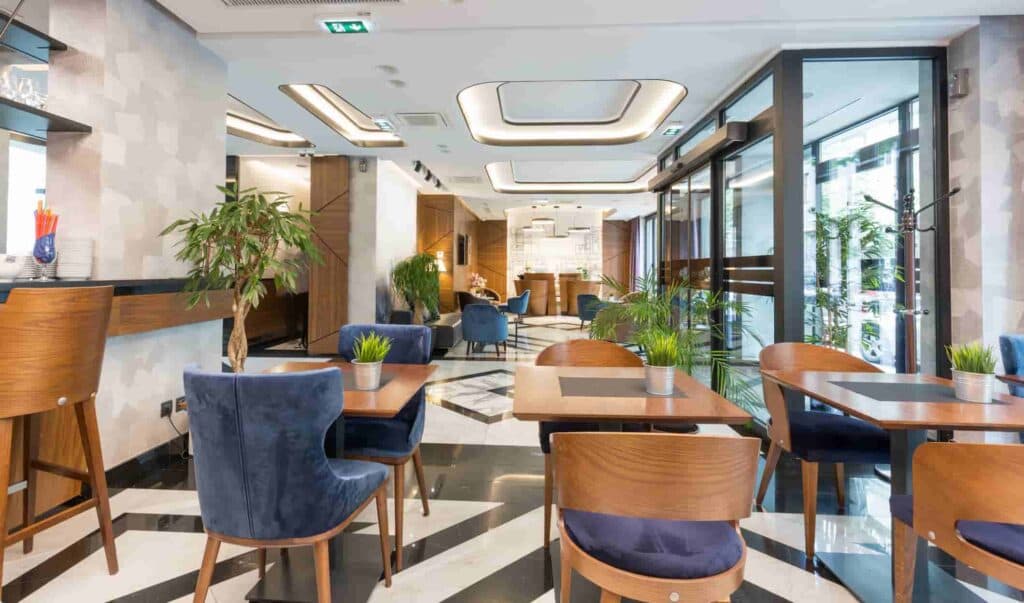
Most procurement mistakes in Ghana hotel restaurant projects start here. Developers who have furnished a standalone restaurant assume the same sourcing logic applies to a hotel. It does not — and the difference is not aesthetic. It is structural, operational, and financial.
A standalone restaurant typically runs one or two service periods per day. A hotel restaurant runs three: breakfast, lunch, and dinner, seven days a week, across a guest population that changes entirely every few days. Chairs are moved, stacked, repositioned, and cleaned dozens of times daily. Tables absorb spills, heat, and repeated surface contact across every service. Upholstery is exposed to cleaning chemicals at a frequency that residential or retail-grade fabrics are not designed to withstand.
The furniture must also function across multiple configurations. The same space that runs a breakfast buffet at 7am needs to support à la carte dining at noon and a private event setup at 7pm. That operational flexibility — reconfiguration, stacking, modular layouts — has to be designed into the furniture at the specification stage, not improvised after installation.
| Criteria | Hotel restaurant | Standalone restaurant |
|---|---|---|
| Daily service periods | 3 (breakfast, lunch, dinner) — every day | 1–2 service periods |
| Usage cycles per year | High — continuous guest turnover | Moderate — predictable covers |
| Layout flexibility required | Yes — events, buffets, group configurations | Optional |
| Design consistency requirement | Must align with full hotel concept | Standalone concept |
| Cleaning cycle intensity | Multiple times daily with commercial products | Once daily, lighter cycle |
| Durability standard required | Contract-grade — 50,000+ Martindale cycles | Commercial but lower threshold |
Choosing non-contract-grade furniture for a hotel restaurant is not a cost-saving decision. It is a deferred cost. In Ghana’s climate — high humidity, heat, intensive daily cleaning — unsuitable materials show visible degradation within 12 to 18 months. Replacement at that point costs more than the original contract-grade alternative would have, and it happens while the hotel is in full operation, disrupting both service and guest experience.
Restaurant furniture Ghana categories in hotel projects should be planned as a complete operational system, not simply as a list of products. Dining tables, dining chairs, booth seating, bar stools, lounge seating, coffee tables, buffet stations, and host stands all support different functions within the restaurant environment.
When planning restaurant furniture Ghana for hotel developments, dining tables must be selected based on seating capacity, table size standards, and service flow. A 2-top, 4-top, or 6-top table configuration directly affects how efficiently space is used during breakfast service, à la carte dining, and peak hours. These configurations should follow restaurant table size standard guidelines to ensure proper seating comfort, spacing, and operational efficiency. Chairs must be strong enough for continuous daily use while maintaining comfort and stability. Choosing the right restaurant chairs Ghana is critical to ensure durability, comfort, and long-term performance in high-traffic hotel dining environments.
Booth seating requires custom manufacturing aligned with wall dimensions, circulation flow, and restaurant zoning. Bar stools and lounge seating must balance design aesthetics with contract-grade durability, especially in high-traffic hotel environments where wear and tear is significantly higher. Each category within restaurant furniture Ghana has specific technical requirements. Chairs require reinforced joints, tables must remain stable under constant movement, and upholstery must resist stains, moisture, and frequent cleaning cycles. A structured category approach helps developers avoid specification errors and ensures consistent performance across all restaurant areas.
Many developers initially consider ready-made options available in local markets. However, restaurant furniture Ghana for hotel projects often requires customization.
Hotel projects typically need:
Custom manufacturing ensures that furniture aligns with architectural drawings and operational needs.
It also provides:
If you are evaluating suppliers, read: hotel furniture supplier for Ghana projects
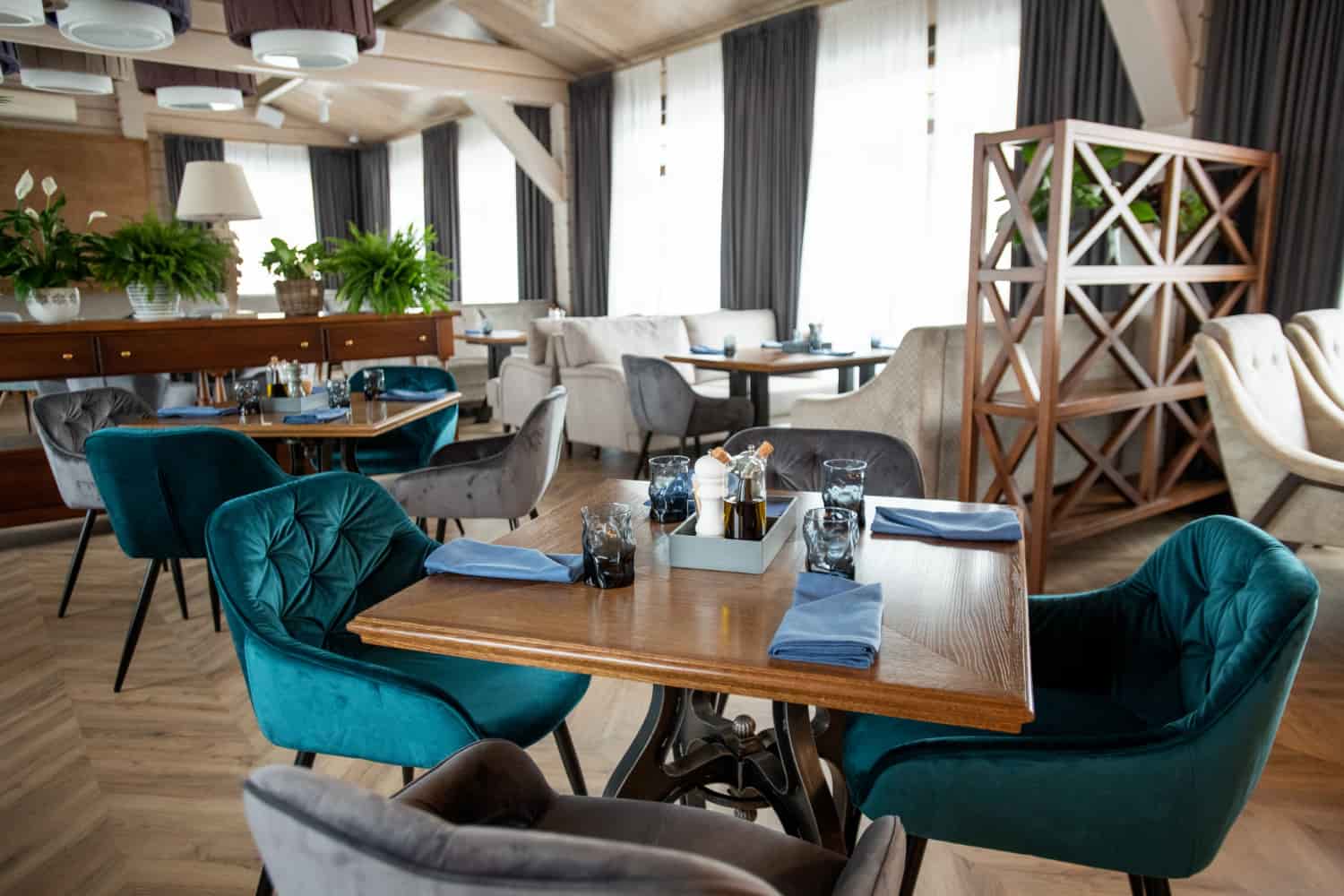
Material selection is one of the most critical decisions in restaurant furniture Ghana planning. Choosing the right restaurant furniture materials Ghana is essential to ensure durability, humidity resistance, and long-term performance in hotel environments.
Recommended specifications for hotel restaurant furniture in Ghana include plywood or high-density MDF structures, commercial laminate or veneer finishes, reinforced chair joints, contract-grade foam density, and solid wood or metal frames. HPL (High Pressure Laminate) is the most robust surface option — resistant to cleaning chemicals, heat, and daily wear. Veneer provides a more natural look but requires more careful maintenance and a correctly sealed topcoat system to perform in Ghana’s coastal humidity.
In coastal cities like Accra, humidity resistance becomes essential. Poor material selection leads to swelling surfaces, joint failures, and finish deterioration within the first operating year. Standard MDF without moisture-resistant treatment absorbs humidity at edges and around fixing points, causing structural loosening that is expensive to correct in an operating restaurant.
In many restaurant furniture Ghana projects, materials that perform well in residential use fail quickly under commercial conditions. High guest turnover, continuous cleaning, and humidity exposure require contract-grade materials designed specifically for hospitality environments. Commercial contract furniture standards, such as those defined by BIFMA, provide clear durability benchmarks that help developers specify the correct material grade for hotel restaurant environments.
Restaurant furniture layout directly impacts revenue and operational efficiency in hotel projects. A well-planned restaurant seating layout Ghana helps balance seating capacity, circulation flow, and guest comfort to maximize revenue per square meter.
Seating layout is not a design preference — it is a revenue decision. How many covers a restaurant can serve per hour is determined before a single piece of furniture is ordered, at the floor plan stage. The benchmarks used across contract hospitality projects are consistent: fine dining requires 1.3–1.6 m² per seat, casual dining requires 1.0–1.3 m² per seat, and buffet layouts require an additional 0.3–0.5 m² per seat for circulation. A 10–15% improvement in usable seating is achievable through structured layout planning before procurement begins. For a mid-market hotel restaurant in Accra running 200 covers per day, that margin compounds into a meaningful figure over a year of operations — without adding a single square meter of floor space.
Most Ghana hotel projects arrive at furniture procurement without a finalized floor plan. Layout decisions then get forced under time pressure — tables are placed to fill the room rather than to optimize service flow. The result is predictable: reduced seating capacity, inefficient waiter circulation, and slower table turnover during peak hours. The discipline required is not complex: lock the floor plan before writing the supplier brief. Table configurations (2-top, 4-top, 6-top), aisle widths (minimum 90cm, 120cm for main service corridors), and buffet station placement all need to be fixed before production begins. Changing these specifications after production starts adds 3–6 weeks to the project timeline and typically triggers partial repricing.
| Layout factor | Impact on operations |
|---|---|
| Table spacing | Directly determines seating capacity and cover count per service |
| Aisle width | Affects service speed — min 90cm standard, 120cm main corridors |
| Circulation flow | Prevents bottlenecks during peak breakfast and dinner service |
| Seating mix | 2-top, 4-top, 6-top balance optimizes revenue per m² |
| Buffet station placement | Must be fixed before production — changes add 3–6 weeks |
Restaurant furniture Ghana cost planning is one of the most misunderstood areas in hotel development. Many developers focus only on unit prices, but total project cost depends on multiple factors. For more accurate budgeting, see restaurant furniture cost Ghana.
Restaurant furniture cost for hotel projects in Ghana typically ranges between $80 and $250 per seat, depending on material quality, customization level, and project scale. The table below provides a general cost overview for key furniture categories.
| Furniture type | Typical cost range |
|---|---|
| Dining chairs | $40 – $120 |
| Dining tables | $120 – $350 |
| Booth seating | $150 – $400 per seat |
| Bar stools | $60 – $180 |
Restaurant furniture cost in Ghana hotel projects is influenced by multiple interconnected factors. Material quality is the primary driver — higher-grade materials improve durability while increasing initial investment, but reduce replacement costs significantly over the hotel’s operating life. Customization level adds production complexity: projects requiring unique dimensions, brand-specific finishes, or specialized upholstery increase cost but are often unavoidable in hotel projects where design consistency across all areas is a brand requirement. Construction detail — reinforced bases, strengthened joints, integrated booth structures — improves long-term performance but increases production cost. Logistics and packaging must also be included in the total budget: export-grade packaging, container optimization, and installation requirements all contribute to the final figure. Developers who evaluate cost as a complete system rather than isolated unit prices achieve more accurate budgeting and better long-term value.
Many hotel projects in Ghana underestimate restaurant furniture costs by focusing only on unit prices instead of total project cost. Hidden expenses such as logistics, installation, packaging, and replacement risk often increase the final budget significantly. Lower-cost options that fail within 18 months in Ghana’s climate cost more over a 5-year operating period than contract-grade alternatives specified correctly from the start.
Many hotel developers choose to import restaurant furniture Ghana from Turkey due to cost-quality balance and manufacturing expertise. Turkey offers a strong hospitality furniture industry, competitive pricing versus Europe, higher quality versus low-cost markets, and genuine custom manufacturing capability for hotel-scale projects.
Turkish manufacturers specialise in project-based contract furniture production — they do not simply produce items from a catalogue, they manage the full process from technical drawings through sample approval, mass production, and export packaging. For Ghana hotel projects, this matters because furniture must arrive with matched finishes, consistent quality across every room and table, and packaging that survives the Turkey-to-Tema sea route intact. Turkish factories that have completed previous West Africa projects have already navigated Ghana Revenue Authority documentation requirements, Tema Port customs classification, and the logistics coordination challenges that first-time exporters encounter on almost every shipment.
The standard shipping sequence for restaurant furniture from Turkey to Ghana covers: production completion and pre-shipment inspection, export packaging with moisture and impact protection, container loading with area-grouped furniture, sea freight to Tema Port (typically 18 to 24 days), customs clearance (5 to 15 working days under normal conditions), and inland delivery to the project site. Total timeline from production completion to furniture on site runs 4 to 6 weeks. For the complete container loading and export documentation framework, see the export hotel furniture to Ghana guide.
Restaurant furniture procurement from Turkey for a Ghana hotel project requires a minimum 10 to 14 week lead time from BOQ finalisation to furniture on site — covering 6 to 10 weeks production, 3 to 4 weeks sea freight, and 1 to 2 weeks customs clearance and inland delivery. The restaurant area procurement timeline must be confirmed before the hotel’s overall FF&E schedule is locked. Late restaurant furniture procurement is one of the most common causes of phased opening — where rooms open on schedule but the restaurant follows 4 to 6 weeks later.
Project-based manufacturers deliver better results in hotel restaurant projects because they manage furniture as a complete operational system, not as separate product orders. Restaurant chairs, tables, booth seating, bar stools, and buffet units must work together in terms of layout, durability, finish consistency, and delivery timing — and this coordination only happens reliably when a single manufacturer controls the entire scope.
Unlike general suppliers, project-based manufacturers understand hospitality requirements such as high daily usage, repeated cleaning cycles, seating capacity, and long-term maintenance performance. This makes them more suitable for Ghana hotel projects where restaurant furniture must support both guest experience and revenue efficiency. A general furniture supplier can produce a chair that looks correct. A project-based hospitality manufacturer produces a chair that performs correctly — under 50,000 Martindale fabric cycles, daily commercial cleaning, and the structural stress of being moved, stacked, and repositioned dozens of times per service period.
Project-based manufacturers provide stronger coordination between design, material selection, production, quality control, packaging, and export logistics. This reduces the risk of mismatched finishes, weak construction, delayed delivery, or inconsistent quality across different restaurant zones. In Ghana hotel projects, where furniture arrives in a single container and correction cycles run 12 to 14 weeks, this coordination is not a premium service — it is the baseline requirement. Before choosing between local suppliers, import options, or factory-direct production, developers should review a detailed hotel furniture comparison to evaluate cost, quality, lead time, and long-term project risk more clearly.
A successful restaurant furniture strategy in Ghana hotel projects is not defined by design alone, but by how effectively layout planning, material selection, production, and logistics are aligned from the beginning. Many hotel restaurant projects focus heavily on visual concepts, yet overlook operational efficiency. In practice, the most common problems — low seating capacity, slow service flow, early material failure, and high maintenance costs — are not caused by design, but by weak planning and poor coordination between project stages.
The most effective projects treat restaurant furniture not as individual items, but as a complete operational framework that directly affects revenue, guest experience, and long-term performance. Every decision, from table size to chair durability and layout flow, is made with both functionality and efficiency in mind. Material selection is especially critical in Ghana’s climate. Furniture must resist humidity, heavy daily use, and continuous cleaning cycles. Choosing contract-grade materials ensures longer lifespan, reduces replacement costs, and maintains consistent quality over time. Production and supplier strategy also play a key role — working with experienced manufacturers who understand hospitality standards ensures consistency, scalability, and reliable execution. This becomes even more important in export-based projects, where adjustments after delivery are limited and costly.
Logistics coordination completes the system. Even high-quality furniture can create operational issues if shipping, container planning, and installation timing are not aligned with the project schedule. A well-coordinated process ensures smooth delivery and faster project completion. In Ghana’s growing hospitality market, developers who approach restaurant furniture planning strategically gain a clear competitive advantage — they optimize space usage, improve operational efficiency, and maximize revenue potential within the same physical area. Every successful restaurant furniture project in Ghana is built on decisions made in the right sequence: layout before brief, specification before sampling, logistics before the container books.
Restaurant furniture Ghana for hotel projects refers to commercial-grade furniture designed specifically for hotel dining areas, including chairs, tables, and seating systems built for high usage. In hotel projects, this furniture must support durability, layout efficiency, and consistent design standards to ensure long-term performance and optimal revenue per square meter.
Restaurant furniture cost in Ghana hotel projects typically ranges between $80 and $250 per seat, depending on material quality, customization level, and project scale. Total cost is usually calculated per seat or per square meter and can increase with higher durability requirements, complex layouts, and export logistics.
Imported furniture, especially from Turkey, often offers better quality, customization, and long-term durability for hotel projects.
Production usually takes 6–10 weeks, depending on customization and project scale.
The best materials for restaurant furniture Ghana projects include treated plywood, solid wood, metal frames, and commercial-grade upholstery, all designed to resist humidity, heavy usage, and frequent cleaning. Choosing contract-grade materials ensures longer lifespan, consistent performance, and lower long-term maintenance costs in hotel environments.
Choosing the right restaurant furniture supplier requires evaluating experience in hospitality projects, production capacity, customization capability, and quality control systems. For Ghana projects, it is also important to select suppliers with export experience to ensure smooth logistics, consistent quality, and on-time delivery.
The most common mistakes include choosing residential-grade furniture, ignoring layout planning, focusing only on initial cost, and working with inexperienced suppliers. These issues often lead to reduced seating capacity, higher maintenance costs, and operational inefficiencies in hotel restaurant projects.
Restaurant furniture layout directly affects revenue by influencing seating capacity, service efficiency, and table turnover rate. Optimized layouts increase the number of usable seats and improve operational flow, allowing hotels to generate higher revenue per square meter without expanding space.
WhatsApp us