| Hotel category | Est. cost per key (landed) | Material level | Typical scope |
|---|---|---|---|
| Budget / 2–3 star | $800 – $1,400 | HPL on MR-MDF, steel frames | Bed, wardrobe, desk, nightstands |
| Mid-range / 4-star | $1,400 – $2,200 | Veneer or premium HPL, solid wood | Full room package + upholstered headboard |
| Upscale / 5-star | $2,200 – $4,000+ | Custom: lacquer, stone, solid hardwood | Full custom FF&E, all zones |
| Boutique / design hotel | $3,000 – $6,000+ | Bespoke materials, unique finishes | Full concept-driven FF&E package |
In many hotel projects, budgets increase not because initial prices are wrong, but because key cost drivers are underestimated. Material upgrades, packaging standards, logistics complexity, and installation requirements often add significant costs after supplier selection. The total landed cost of hotel furniture in Ghana is typically 35 to 50 percent above the factory price — a gap that must be built into the project budget before any supplier is briefed, not discovered after the container arrives.
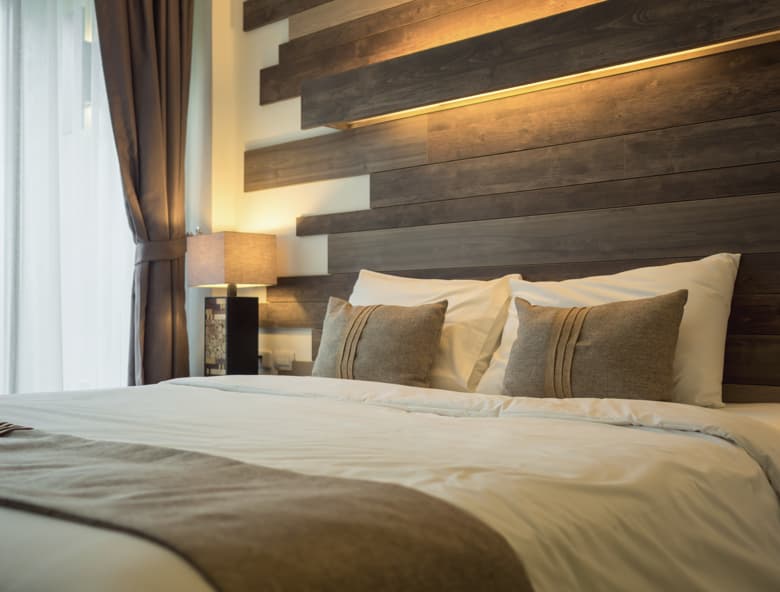
It’s normal to check hotel bedroom set price Accra as a baseline. Yet hotel rooms need stronger builds and faster maintenance than retail sets. A hotel bed base should support repeated load, housekeeping movement, and quick repairs. That’s why hotel bed base price Ghana changes dramatically based on internal frame, board thickness, center support, and hardware.
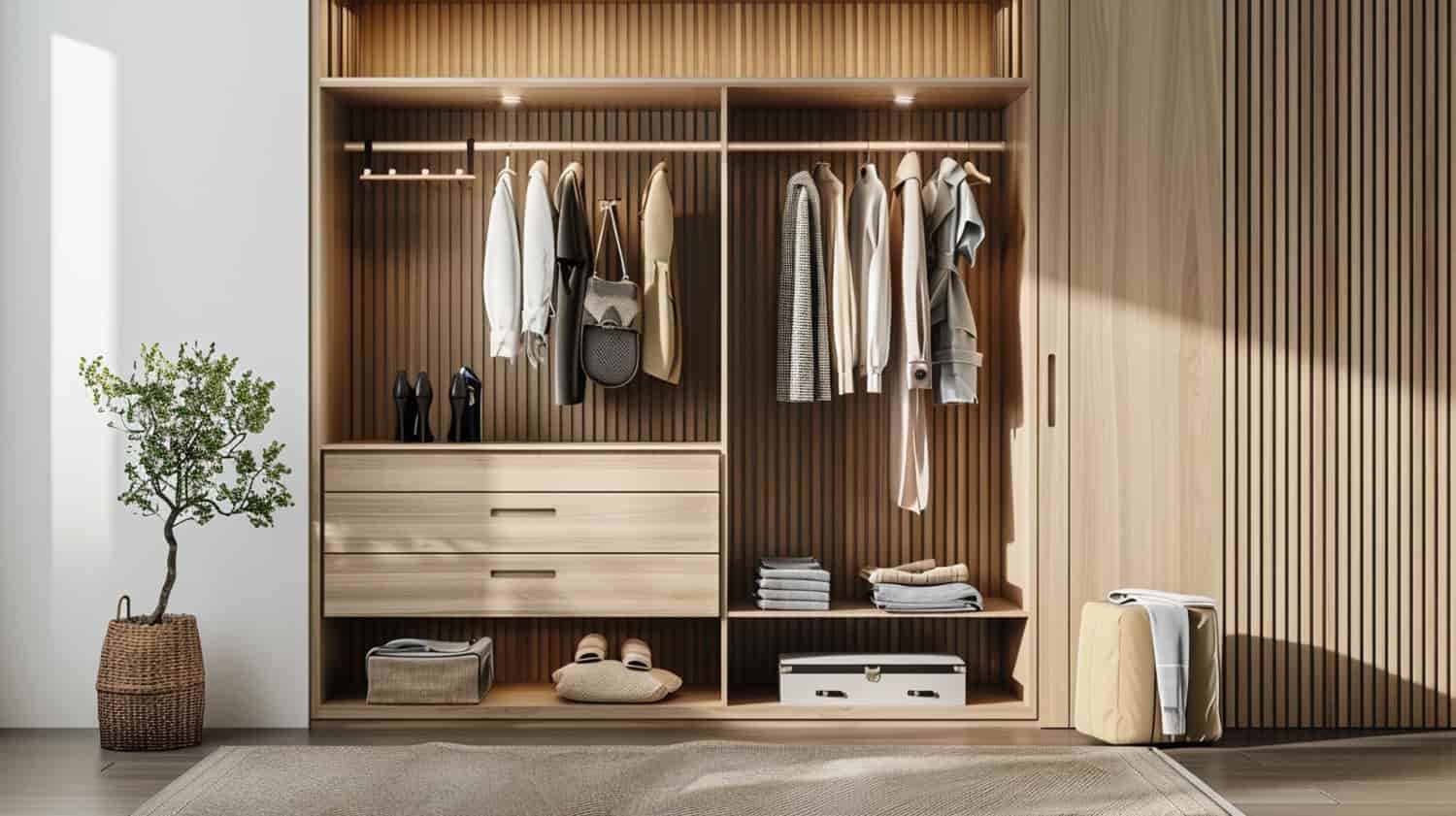
The same logic applies to storage. People often search hotel wardrobe price Ghana, but wardrobes range from simple units to hotel-grade modular systems with stronger hinges, thicker shelves, and a finish that resists moisture and cleaning chemicals. When you price wardrobes, decide early whether you need a standard closet, an integrated minibar wall, or a full TV/wardrobe joinery look—each version shifts cost.
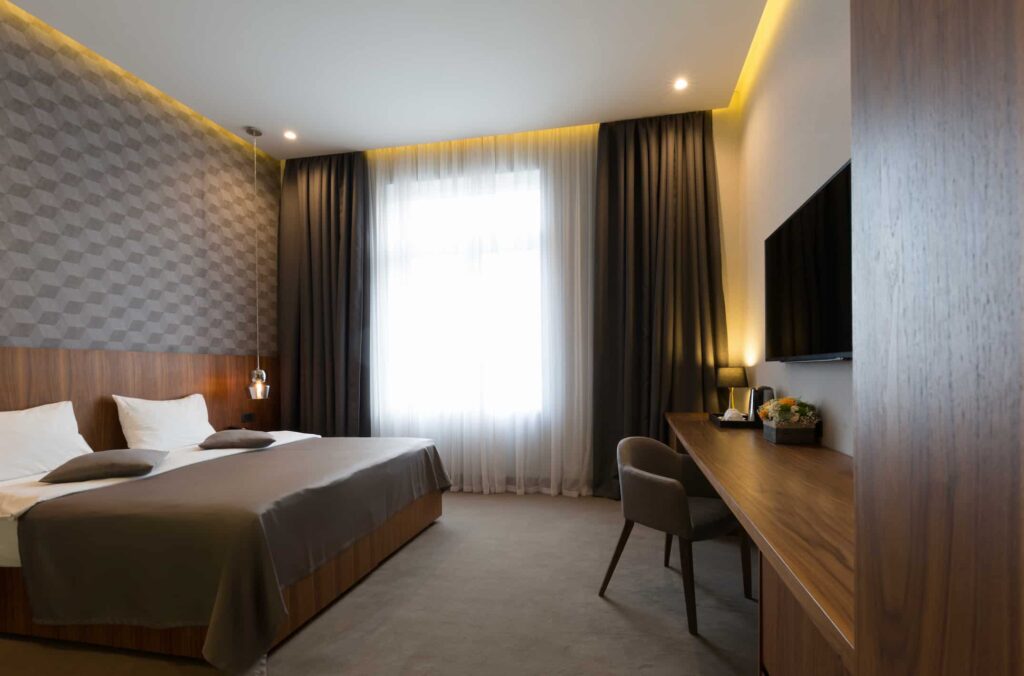
Guestroom furniture forms the largest portion of hotel furniture cost in Ghana, as it includes essential items such as beds, wardrobes, desks, bedside tables, and TV units. These elements are produced as part of a complete package, where material quality, construction methods, and finish standards directly influence both price and long-term durability.
Instead of evaluating each item separately, hotel developers should consider how these components function together as a system. Poor coordination between elements can lead to inconsistencies in quality, visual alignment issues, and increased maintenance costs over time.
Reviewing a complete guest room furniture package for hotels helps you standardize these items and control costs more effectively across all rooms. Once these are standard, you can upgrade the “feel” with fabric, lighting coordination, and finishing details without changing the entire structure. You can also compare global sourcing options in this hotel furniture comparison guide.Developers and designers often look up hospitality furniture Accra when they want commercial-grade performance. That performance premium is real—and it’s usually worth it. The cost difference often comes from:
Developers and designers often look up hospitality furniture Accra when they want commercial-grade performance. That performance premium is real — and it’s usually worth it.
The durability premium in hospitality furniture comes from structural and material upgrades that directly affect long-term performance. Stronger internal frames and improved joinery systems increase load resistance, while thicker panels and high-quality edge banding prevent deformation over time. Seating elements require commercial-grade foam density and upholstery designed to withstand stains, abrasion, and frequent cleaning. Durable hardware systems ensure that moving parts such as drawers and doors perform reliably under continuous use.
If your hotel is new, this matters even more. Early wear creates negative reviews faster than you’d expect, and replacing furniture after opening is always more expensive and disruptive than doing it right from the start. This is especially important in hotel furniture for new hotel projects Ghana, where early furniture decisions directly affect long-term durability and operational performance.
The most consistently repeated hotel furniture cost mistake in Ghana projects is treating the factory price as the project budget. A factory quote of $144,000 for an 80-room hotel at $1,800 per room becomes a landed cost of $195,000 to $216,000 after freight, Ghana duties, packaging, inland delivery, and installation — a gap of $51,000 to $72,000 that was never in the budget. This gap is not negotiable and not avoidable. It must be calculated before any supplier is briefed, using the correct landed cost formula: factory price × 1.35 to 1.50 as the minimum planning figure for Ghana hotel furniture projects.
Ghana’s coastal cities — Accra, Tema, and Takoradi — maintain relative humidity above 70 percent for most of the year. At this level, the cost difference between MR-MDF and standard MDF (approximately 8 to 12 percent per panel) is not a budget decision — it is a lifecycle decision. Standard MDF in coastal Ghana conditions shows swelling, hinge loosening, and surface delamination within 12 to 24 months. The replacement cost of a 100-room property’s wardrobes at year 2 is multiples of the original MR-MDF premium. For outdoor furniture specifically, aluminium frames at 15 to 25 percent above powder-coated steel cost return that premium within the first replacement cycle that steel requires and aluminium does not.
Restaurant furniture Ghana price is one of the most searched cost benchmarks for hotel developers, and for good reason — the restaurant is the highest-wear furniture zone in any hotel. Chairs in a hotel restaurant are moved dozens of times daily across tiled floors, stacked and unstacked during service resets, and cleaned repeatedly with chemicals that degrade inferior surface finishes. A chair that looks equivalent to a contract-grade option at the point of purchase can fail structurally within a year under these conditions, while a properly specified contract chair will perform reliably for five to seven years under the same usage pattern.
The specification decision that matters most for restaurant seating is frame construction. In high-traffic commercial dining environments, the failure point is almost always the joint between the leg and the seat frame — not the surface finish, not the upholstery, not the hardware. A solid beech or rubberwood frame with mortise-and-tenon or steel-reinforced joints will outlast a dowel-jointed frame by several years under identical conditions. That structural difference is not always visible in a product photograph or a supplier’s quotation, which is why evaluating restaurant seating on frame specification rather than price per chair produces significantly better long-term outcomes.
For hotel restaurant tables, HPL surfaces on moisture-resistant substrates are the correct specification for Ghana projects. They resist the heat of plates, the chemicals in cleaning products, and the impact of daily service — and they are easy to maintain without specialist products. Veneer and lacquer finishes are appropriate for upscale restaurant environments where aesthetics justify the additional maintenance requirements, but only when the property has the operational capacity to maintain them correctly. Specifying a premium surface finish without a maintenance plan is not a design upgrade — it is a cost liability that appears on the maintenance budget rather than the procurement budget.
Restaurant chairs are one of the most frequently replaced furniture items in hotels due to continuous use. Choosing lower-cost options often results in higher long-term expenses due to breakage, repairs, and frequent replacement cycles. A contract-grade chair at $80 per unit that lasts 6 years costs less over the hotel’s operating life than a residential-grade chair at $45 that requires replacement at year 2 — particularly when replacement happens in an operating restaurant, with disruption costs added to the unit price.
Outdoor hotel furniture Ghana operates under the most demanding conditions of any furniture zone in the property. Pools, terraces, balconies, and garden lounges in Ghana’s coastal climate face intense UV radiation, salt air, high humidity, and heavy rainfall. A developer who specifies correctly from the start should expect seven to ten years of serviceable performance from the same investment that would fail in three years if specified incorrectly.
Aluminium frames are the correct structural choice for outdoor hotel furniture in Ghana. They do not rust, do not absorb moisture, are light enough for staff to reposition easily, and maintain structural integrity under Ghana’s thermal cycling. Powder-coated steel is an acceptable alternative where budget constrains aluminium, but requires more careful maintenance. Natural rattan and untreated wood deteriorate rapidly in coastal conditions and should not be specified for fully exposed outdoor settings.
Cushion fabrics for outdoor seating need UV-stabilised, solution-dyed acrylic or equivalent marine-grade textiles. Standard upholstery fabrics fade and degrade under Ghana’s UV conditions within months. Quick-dry foam cores prevent the moisture retention that leads to mould and structural deterioration. These specifications add a modest premium of 15 to 25 percent above standard outdoor furniture pricing — and return that premium many times over in reduced replacement costs over the property’s first five years.
For new builds and renovations, many developers prefer a hotel furniture manufacturer in Turkey because it supports one critical goal: consistency across rooms. Consistency in hotel furniture is not an aesthetic preference — it is an operational requirement.
Turkish contract manufacturers are structured around project-based production — not catalogue orders or residential supply. A factory built for hospitality projects receives a BOQ, develops shop drawings, aligns production across casegoods and upholstery categories, and manages the full export process as a coordinated system. That integration reduces the number of coordination failures that can occur between production, packaging, and shipping. For a developer managing a Ghana hotel project remotely, that reduction in coordination complexity has real financial value.
Turkey’s geographic position gives it competitive sea freight transit times to West Africa compared to Asian sourcing regions. Manufacturers with established West Africa export experience understand Tema Port documentation requirements and the packaging standards that protect furniture across a five-week ocean transit. For developers evaluating specific factories, a structured assessment framework is covered in the guide on how to choose a hotel furniture manufacturer in Turkey.
Turnkey hotel furniture Ghana reflects a real operational preference. Developers who have managed hotel fit-out projects across multiple suppliers understand exactly what coordination complexity looks like — different production schedules, different shipping timelines, different documentation requirements, and different points of contact for every problem that arises.
A genuine turnkey supplier — one who manages the complete room package from a single production system — eliminates most of that coordination risk. Guest room casegoods, lobby upholstery, restaurant seating, and outdoor furniture produced under one quality standard, packed in one container sequence, and cleared through Tema under one set of documents is fundamentally less likely to produce the installation delays that push back opening dates and convert furniture savings into revenue losses.
The scope definition is the critical step before committing to a turnkey approach. Which rooms and public areas are included? Which finishes must match across categories, and how will that match be verified at sample approval stage? Which items require a spare parts reserve? When these questions are answered before the supplier brief is written, the turnkey arrangement delivers its full value. For a structured approach to evaluating suppliers, the guide on hotel furniture supplier for Ghana projects covers the capability assessment process in detail.
Estimates based on typical Turkish manufacturer pricing for Ghana hotel projects, including sea freight, Ghana import duties (~20–25%), packaging, inland delivery, and installation. Factory price range × 1.35–1.50 = total landed cost. Use as a planning reference only.
Reliable hotel furniture cost in Ghana quotes depend entirely on how clearly the project is defined before approaching any supplier. A request for quotation that says “hotel furniture for 60 rooms” will return a number — but that number will be an estimate built on assumptions that may not match the developer’s intent.
A quotation that can be relied upon requires four things defined upfront: room count by type, furniture scope by zone (guest rooms, lobby, restaurant, outdoor), material specification level (budget HPL, mid-range veneer, premium custom), and a confirmed project timeline. With those four inputs, a manufacturer experienced in Ghana hotel projects can prepare a price that reflects the actual cost of producing and delivering the furniture to site.
The fastest way to get comparable quotes from multiple suppliers is to prepare a simple scope document before making any contact. Two pages covering room count, furniture items per room type, zone requirements, and finish direction will produce quotations based on the same scope — evaluable against each other on a consistent basis. Without that document, each supplier quotes against their own interpretation of the brief, and the developer spends time reconciling differences in scope rather than differences in price.
The framework for controlling hotel furniture cost in Ghana without sacrificing performance is straightforward: standardise the structural specification across all rooms, concentrate design investment in the zones where guests engage most directly with furniture, plan for replacement cycles at the procurement stage, and work with suppliers who have verifiable hospitality project experience. These four decisions, made correctly at the planning stage, produce a more predictable budget, a better-performing property, and a lower total cost of ownership over the investment horizon.
A standard 3-star guest room package sourced from Turkey and delivered to site
in Ghana costs $800–$1,400 per key in total landed cost. This includes the bed
base, headboard, wardrobe, desk, and bedside tables — manufactured to
commercial spec, shipped, cleared through Tema Port, and installed. Mid-range
4-star packages with veneer surfaces and upholstered headboards land at
$1,400–$2,200 per key. Factory price alone is 35–50% lower than these figures —
always budget on landed cost, not ex-works price.
Five factors affect hotel bedroom set price Accra most:
1) Board specification —
moisture-resistant MDF costs more than standard but is essential in Ghana’s
humidity.
2) Surface finish — HPL is the budget-correct spec; veneer adds
20–35% to unit cost.
3) Hardware grade — commercial hinges and drawer runners
cost more but last 5x longer under hotel use.
4) Frame construction —
mortise-and-tenon joints vs dowelled frames determine structural lifespan.
5) Customisation level — standard dimensions cost less than room-specific sizing.
Spec decisions made here determine both price and 5-year replacement cost.
Estimate FF&E cost per key Africa in five steps:
1) Build a complete
furniture schedule — list every item per room type with dimensions and
spec level.
2) Multiply by room count per type to get total quantities.
3) Add public areas — lobby, restaurant, and outdoor typically add 20–30%
on top of guest room cost.
4) Get quotes from at least two suppliers using
the same schedule so prices are comparable.
5) Add 35–50% to any factory
price for freight, import duties, port charges, and installation — this
is the actual landed cost, not the ex-works figure. A schedule built this
way gives you a number you can defend to investors and contractors.
The average hotel furniture cost in Ghana per room varies by category: Budget and 2–3 star hotels run $800–$1,400 per key landed; mid-range 4-star hotels cost $1,400–$2,200 per key; upscale 5-star properties range from $2,200–$4,000+ per key; boutique and design hotels reach $3,000–$6,000+ per key. These are total landed costs delivered to site in Ghana — including manufacturing, sea freight from Turkey, import duties, and installation. Factory price alone is typically 35–50% lower than the actual landed figure.
Hotel furniture cost in Ghana is higher than factory price for four reasons:
1) Sea freight from Turkey to Tema Port adds 15–20% on top of manufacturing cost.
2) Import duties, port charges, and customs fees add another 10–15%. 3) Inland delivery from Tema to the project site and installation coordination add 5–10%. 4) Packaging to commercial export standards — foam wrapping, reinforced cartons, moisture barriers — adds cost that budget suppliers often skip, leading to damage claims. Combined, these logistics and compliance costs add 35–50% to the ex-works factory price before a single piece reaches a finished room in Ghana.
WhatsApp us