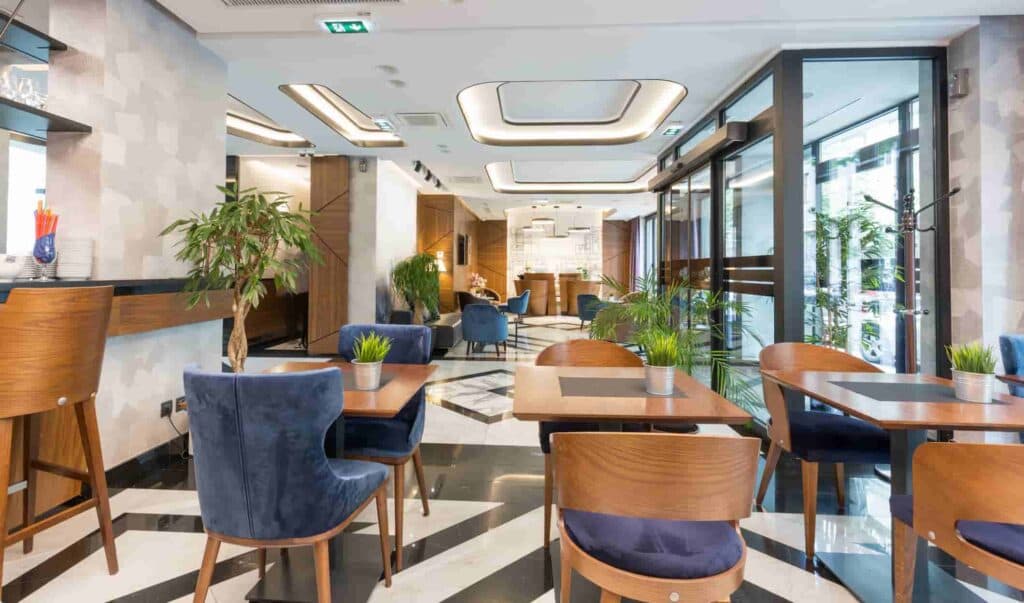
According to BIFMA commercial furniture standards, tables specified below recommended dimensions for their intended use category generate disproportionate replacement and maintenance costs. In high-traffic hotel restaurant environments, under-specified table bases and surfaces show structural fatigue within 18–24 months — replacing them mid-operation carries both direct cost and guest experience disruption.
| Configuration | Minimum Size | Recommended Size | Best Use |
|---|---|---|---|
| 2-person | 60×60 cm | 65×65 cm | Café, quick dining, bar areas |
| 4-person (square) | 70×70 cm | 80×80 cm | Main dining room, buffet supplement |
| 4-person (rectangular) | 70×110 cm | 80×120 cm | Hotel restaurant, group dining |
| 6-person | 80×140 cm | 90×160 cm | Private dining, event configuration |
| Round 4-person | 90 cm diameter | 100 cm diameter | Social dining, lobby restaurant |
Insufficient aisle spacing in Ghana hotel restaurants is consistently cited as a cause of slow service, staff collision incidents, and negative guest reviews. A layout that looks workable on a floor plan at 1:50 scale often fails in practice because service items — trolleys, trays, high chairs — were not factored into clearance calculations. Verify spacing with a physical walkthrough before finalizing the furniture order.
Shape selection interacts with both floor plan geometry and service concept. Square tables are the most flexible: they can be pushed together for larger groups, separated for smaller covers, and rearranged for event configurations with minimal disruption. For Ghana hotel restaurants that regularly switch between breakfast buffet, à la carte lunch, and group dinner service, square modularity is a practical operational advantage.
Rectangular tables maximize cover count in linear layouts but limit reconfiguration flexibility. Round tables improve social dining dynamics — a relevant consideration for the group and family bookings common in Ghana’s mid-market and upscale hotel segment — but their footprint is less efficient per cover than square alternatives. Round tables also require more aisle width to allow comfortable access for all seats.
The most operationally resilient approach for most Ghana hotel restaurants is a mixed configuration: a core of square 4-person tables as the primary layout, supplemented by round tables in social zones and rectangular tables where floor geometry supports it.
Standard dining table height runs 72–75 cm, with 74 cm the most common specification in contract hospitality furniture. Chair seat height is typically 45–46 cm, giving a table-to-seat clearance of 28–30 cm — the ergonomic minimum for comfortable legroom. In Ghana hotel projects sourcing chairs and tables from different manufacturers, confirming these dimensions are compatible before production begins is essential. A 2 cm mismatch between table and chair height creates guest discomfort that is immediately noticeable and difficult to resolve after delivery.
For chair specification details including frame types, upholstery standards, and height compatibility, see restaurant chairs ghana.
The most reliable approach for Ghana hotel restaurant table procurement is to specify table top material and base material together, from the same manufacturer, with a single production run. Mixed sourcing — top from one supplier, base from another — creates dimensional tolerance issues that are only discovered during installation. A 2–3 mm height discrepancy across a room of tables is immediately visible and damages the perceived quality of the entire space.
Table size directly affects cost at three levels: material volume increases with dimensions, custom shapes carry a production premium over standard configurations, and larger tables require stronger base structures that cost more to manufacture correctly. These are not reasons to reduce table dimensions below what the concept requires — they are planning inputs that should be factored into the FF&E budget from the outset.
The more significant cost risk is under-specification followed by early replacement. Tables purchased to a price point rather than a durability standard in Ghana hotel restaurant projects consistently generate replacement costs within 18–24 months that exceed the savings made at procurement. For structured budget planning across the full restaurant FF&E scope, see restaurant furniture cost Ghana.
Table procurement for Ghana hotel restaurant projects follows the same sourcing logic as the broader furniture scope. Turkish manufacturers with hotel contract experience produce tables to specified dimensions with consistent quality control across production runs — a critical requirement when ordering 40–100+ identical tables for a hotel restaurant. Local sourcing offers faster delivery but limited customization and variable quality at contract scale. Chinese sourcing offers lower unit cost but requires careful specification and quality verification.
The decision should be based on the project’s dimension requirements, finish specifications, and timeline — not on unit price in isolation. For a full sourcing comparison, see restaurant furniture Ghana vs Turkey vs China. For supplier evaluation criteria specific to Ghana projects, see restaurant furniture supplier for Ghana projects.
Before finalizing any table order, run your specifications against a structured procurement checklist. Dimensional tolerances, base stability, surface durability, and packaging for Tema Port shipping are all verifiable before production begins. See restaurant furniture checklist Ghana for the full framework.
Knowing the correct dimensions is only half the work. The other half is applying them at the right stage of the project — before decisions become expensive to reverse. In Ghana hotel projects, table size standards should be locked during layout planning, not during procurement. By the time furniture orders are being placed, the floor plan should already have confirmed cover counts, aisle widths, and table configurations validated against the benchmarks in this guide.
The practical sequence: start with the restaurant concept and service format, derive the seating density target from that, calculate cover count against usable floor area, then work backwards to table dimensions and configurations that achieve that count within the spacing rules. This order matters. Projects that start with a furniture catalogue and work forwards to a layout consistently arrive at either too few covers or too little circulation space.
Once dimensions are confirmed, run them against your material specification and supplier capability in a single step. A table dimension that is standard for a Turkish contract manufacturer may require a custom production run from a local Ghana supplier — and that difference affects both cost and lead time. Aligning size, material, and sourcing decisions together avoids the gap risks that typically surface during installation.
The projects that hit their opening dates in Ghana hotel restaurant fit-outs are the ones that finalize table size standards, layout plans, and supplier selection in a single coordinated phase — typically 14–18 weeks before the target opening. Projects that treat these as sequential decisions, each waiting for the previous to complete, consistently run 4–8 weeks late and absorb cost overruns that were entirely avoidable.
The working standards for Ghana hotel restaurants are 60–65×60–65 cm for 2-person tables, 80×80 cm for 4-person square configurations, and 80×120 cm or larger for 4-person rectangular and 6-person tables. These dimensions align with international contract hospitality benchmarks while accounting for Ghana’s service style and group dining patterns common in hotel restaurant environments.
Minimum 70–90 cm between table edges in seating zones, 90–120 cm for primary service aisles, and 120–150 cm for main walkways. In Ghana hotel restaurants that use trolleys for buffet service or room service staging, the 120 cm service aisle minimum is essential. Tighter spacing reduces operational efficiency and creates service bottlenecks that are visible from the first full-capacity service.
Standard dining table height is 72–75 cm, with 74 cm the most common contract specification. Chair seat height should be 45–46 cm, giving 28–30 cm of legroom clearance. When sourcing tables and chairs separately for Ghana hotel projects, confirming height compatibility between manufacturers before production is essential — a mismatch of even 2 cm creates guest discomfort that cannot be resolved without replacement.
Square tables are the most operationally flexible choice for Ghana hotel restaurants that run multiple service formats — breakfast buffet, à la carte, and group dining. They combine easily, separate cleanly, and reconfigure without floor plan disruption. Round tables improve social dining dynamics but are less cover-efficient per square meter. A mixed configuration — predominantly square with round supplements in social zones — balances flexibility with capacity.
Table dimensions determine how many covers fit per square meter, which determines how many guests a restaurant can serve per service period. At typical revenue per cover in Ghana’s hotel segment, a 10–15% difference in seating capacity — entirely achievable through disciplined table sizing and layout planning — represents significant annual revenue variance without any increase in floor space or staffing costs.
HPL (High Pressure Laminate) is the recommended specification for Ghana hotel restaurant table tops. It is moisture-resistant, dimensionally stable under heat and humidity variation, and withstands the chemical cleaning concentrations used in commercial restaurant environments. Veneer without adequate sealing and untreated wood surfaces degrade rapidly in Ghana’s tropical conditions, generating replacement costs within two years of installation.
Standard dimensions — based on the benchmarks outlined in this guide — should be the default for most Ghana hotel restaurant projects. Custom sizing is justified when the floor plan geometry makes standard configurations operationally inefficient, or when the hotel concept requires distinctive table dimensions as part of its design brief. Custom production adds cost and lead time; it should solve a specific layout or concept problem, not be the default procurement approach.
WhatsApp us