Hotel wardrobe specification must define door type, external dimensions, complete internal layout (hanging rail positions, shelf count, safe housing, luggage shelf), substrate (MR-MDF throughout including internal panels), surface finish, hinge or slide mechanism with cycle count (minimum 100,000 for hinges, 50,000 for slides), and edge banding specification. In Ghana’s coastal humidity, MR-MDF is mandatory — not standard MDF — and must extend to all internal panels, not just external surfaces. A wardrobe BOQ that defines only external dimensions and finish is not a specification — it is an incomplete brief that leaves every construction detail to the manufacturer’s cost preference.
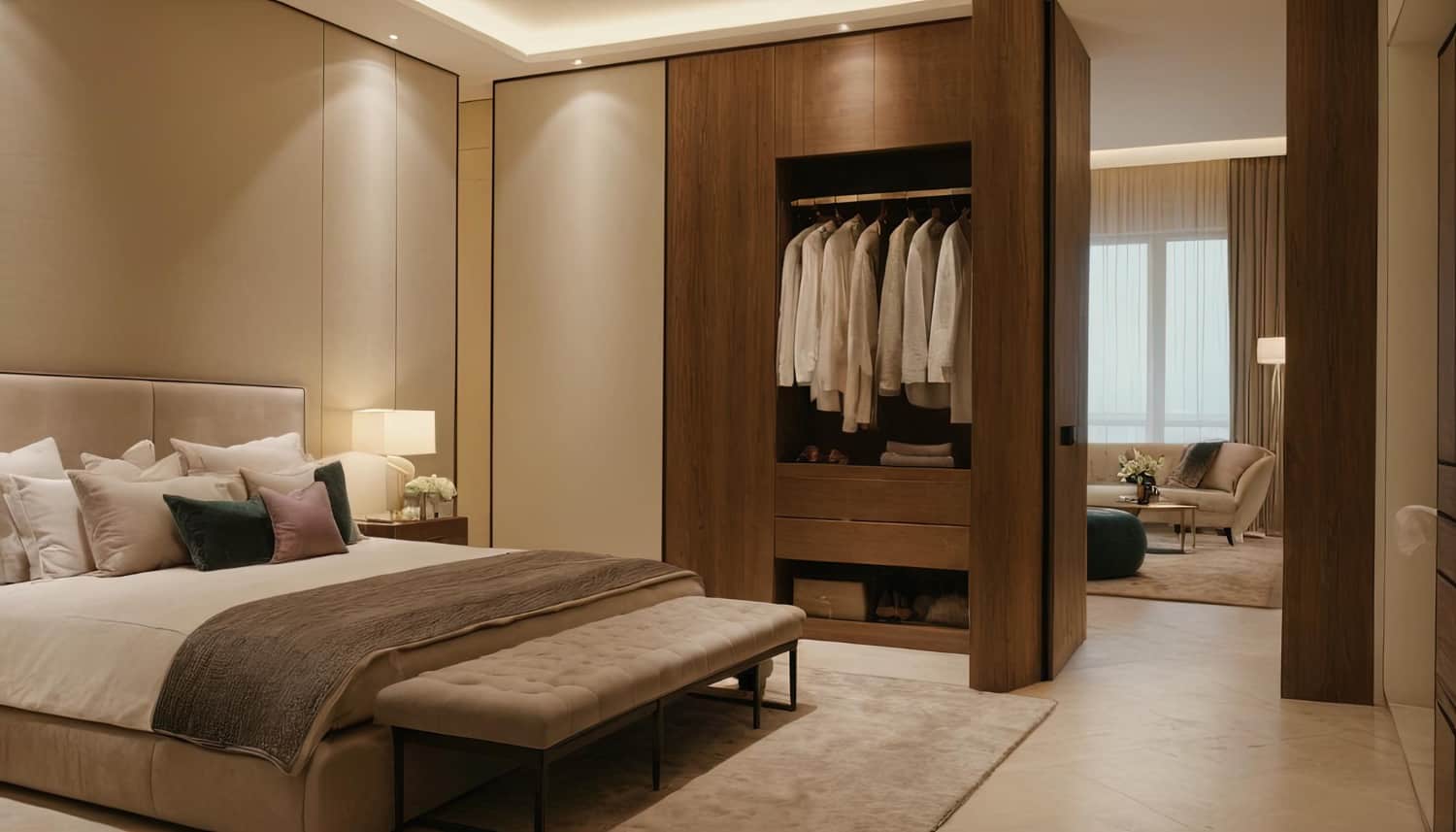
Wardrobe door type selection is the first and most consequential wardrobe specification decision because it affects room layout clearances, installation requirements, operational maintenance, and the visual character of the guest room simultaneously. The choice between hinged, sliding, and open wardrobe configurations is not primarily an aesthetic decision — it is a spatial, operational, and specification decision with implications that run through the entire guest room planning process.
Hinged door wardrobes are the most common specification in three-star and four-star Ghana hotel guest rooms. They offer the clearest internal access — both doors open fully, exposing the complete interior simultaneously — and they have a straightforward construction that is easily maintained and repaired. The specification requirement is wall clearance: a hinged wardrobe door requires 500 to 600mm of clear floor space in front of the door swing. This clearance must be confirmed against the room layout plan before the wardrobe is specified — a room where the bed, desk, or circulation corridor reduces the available clearance below this threshold cannot accommodate a standard hinged door wardrobe without a layout adjustment. Hinge specification must define cycle count (minimum 100,000 cycles for hotel use), soft-close mechanism, and the mounting method appropriate for the door weight. A heavy wardrobe door — 20kg or above for full-height doors — requires concealed hinges rated for the door weight, not standard cabinet hinges that are designed for lighter residential applications.
Sliding door wardrobes eliminate the clearance requirement in front of the wardrobe by replacing the swing with a lateral slide along a top-mounted or floor-tracked rail system. They are the correct specification for rooms where floor area is constrained and the 500 to 600mm door swing clearance would reduce the functional circulation corridor below acceptable standards. The trade-off is that sliding doors do not expose the full wardrobe interior simultaneously — one panel always obscures a portion of the interior. This is operationally acceptable but aesthetically less open than a hinged configuration, which affects visual quality in photography and guest perception in premium categories. The sliding mechanism must be specified by cycle count — minimum 50,000 cycles for the slide rail system — and the rail material must be appropriate for the door weight. A full-height sliding wardrobe door can weigh 25 to 35kg; a slide rail system specified for lighter residential doors will show accelerating wear within the first two years of hotel occupancy.
Open wardrobes — without doors — are used in lifestyle, boutique, and budget hotel concepts where the design supports open storage. They are simpler and less expensive to produce than doored configurations and eliminate all hardware maintenance requirements. The operational trade-off is significant: every room must maintain a visually ordered wardrobe interior for guest photography, and housekeeping must restore the open wardrobe to a presentable state on every room turnover. In high-occupancy properties where room turnovers are rapid, the housekeeping time required to maintain an open wardrobe to a consistent standard adds measurable labour cost that is not present in doored configurations. For full-height open wardrobe options and panel production specifications, see the hotel wardrobe manufacturer page.
Hotel wardrobe dimensions are determined by the room — not selected independently and then fitted into the room layout. A wardrobe that is 100mm wider than the alcove prepared for it, or 80mm shallower than the specification required, creates an installation problem that cannot be corrected without remaking the piece. All wardrobe dimensions must be confirmed against the construction drawings before the BOQ is written.
Standard hotel wardrobe width ranges from 900mm for a single-bay configuration to 1800mm for a two-bay configuration. The width is determined by the available wall space in the room layout and the internal layout requirements — a wardrobe with a 900mm hanging section and a 400mm shelving section requires a minimum 1300mm external width to accommodate both sections with panel thicknesses. Standard hotel wardrobe depth runs 550 to 600mm — the minimum depth to accommodate standard clothes hangers (450mm minimum hanging depth from back panel to door face) plus a back panel and door thickness. A wardrobe specified at 500mm depth creates a functional problem: hangers contact the door face when the wardrobe is closed, creating accelerated wear on both the hanger and the door interior surface. Standard hotel wardrobe height is floor-to-ceiling or fixed at 2100 to 2200mm. Floor-to-ceiling wardrobes eliminate the horizontal surface above the wardrobe that accumulates dust and requires cleaning — an operational advantage in high-occupancy properties that justifies the marginal additional production cost.
Wardrobe dimensions must be coordinated with three adjacent elements before production begins. First, the room’s structural dimensions — alcove width and depth must be confirmed from the construction drawings, not assumed from the design concept. Second, the ceiling height and any services running above the wardrobe position — fan coil units, sprinkler heads, and cable trays above the wardrobe affect the available height and must be identified before the wardrobe height is confirmed. Third, the mirror specification — if the wardrobe includes a full-length external mirror, the mirror position and fixing method must be coordinated with the room’s bedside lamp positions to avoid mirror reflections that create glare for guests in bed. The nightstand specification must also confirm that nightstand dimensions do not conflict with the wardrobe door swing in the same corner zone. For how nightstand dimensions coordinate with the wardrobe in the same room, see the hotel nightstand supplier guide.
Internal layout specification is where the majority of wardrobe BOQs in Ghana hotel projects are incomplete — not because developers are careless, but because internal layout looks like a detail that the manufacturer will figure out, when in practice it is a series of decisions that directly determine whether the wardrobe functions correctly for hotel guests.
The hanging rail section requires definition of: rail length (typically 800 to 1000mm for a single bay), rail height from the wardrobe floor (typically 1600 to 1800mm for full-length hanging, 900 to 1000mm for short-hang configurations that allow a shelf below), rail material and diameter (25mm chrome-plated steel is the standard hotel specification — thinner rails bend under loaded hangers within the first year), and whether the configuration is full-length hang, double-hang, or a combination. A double-hang configuration — two rails at half the standard height, one above the other — doubles the hanging capacity in the same horizontal space but requires that guests use it for shirts and jackets rather than full-length garments. This is a conscious operational decision that affects the wardrobe’s function for guests and must be specified, not assumed.
Every shelf position must be specified by height from the wardrobe floor and by shelf depth. A wardrobe with a “shelf above the hanging rail” specified in the BOQ but without a defined height allows the manufacturer to position the shelf at whatever height suits their standard production template — which may not align with the headroom a guest needs to access the shelf comfortably. A safe housing — the recessed or surface-mounted space for a room safe — must be specified with exact dimensions matching the safe model selected for the property, and its position must allow a guest to operate the safe from a standing or kneeling position without removing items stored on adjacent shelves. A luggage shelf — the horizontal surface at low level for placing an open suitcase — must be specified at a height that allows a standard suitcase to open without contacting the shelf above it: minimum 500 to 550mm clear height between the luggage shelf surface and the shelf above.
Verify MR-MDF compliance on every panel sample — not just the external carcass panels. Request a cut edge from an internal shelf sample and a drawer bottom sample separately. Green core confirms MR-MDF, cream core confirms standard MDF. A manufacturer who supplies external panels in MR-MDF but internal panels in standard MDF is technically meeting a poorly written specification — one that said “MR-MDF carcass” without specifying internal panels. The BOQ must say “MR-MDF throughout — all panels including internal shelves, drawer bottoms, and back panels.”
The most expensive wardrobe specification error in Ghana hotel projects is not wrong dimensions or finish — it is standard MDF substrate in a coastal property. A wardrobe with wrong dimensions can be remade. A wardrobe with standard MDF substrate in Accra or Tema will show hinge loosening and door misalignment within 18 to 24 months — in every room — creating a property-wide maintenance problem that requires either accepting degraded guest room quality or replacing wardrobes at full cost across the entire property. Specifying MR-MDF adds 5 to 8 percent to the wardrobe unit cost. Replacing wardrobes at year 3 costs multiples of the original production value.
Wardrobe hardware specification covers hinges, drawer slides, handles, locks, and any integrated mechanisms such as pull-out trouser racks or tie holders. Each hardware element must be specified by performance — cycle count and load rating — not by appearance or generic quality description.
Hotel wardrobe hinges must be specified at minimum 100,000 cycles — equivalent to approximately 10 years of daily use at 25 to 30 open-close cycles per day. This threshold is not conservative; a hotel wardrobe door opened and closed by multiple guests per day in a high-occupancy property reaches 100,000 cycles in 8 to 10 years. Hinges specified below this threshold will show increasing resistance and eventual failure before the wardrobe reaches its expected replacement age. Specify a named brand with a published cycle rating — Blum, Grass, Hettich, and Häfele are the standard reference brands for European-standard hotel furniture production. Anonymous hardware at an unspecified cycle count is not a hotel specification. All hinges must incorporate a soft-close mechanism — a wardrobe door closing with audible impact in a hotel room at night is a guest experience failure that generates reviews and cannot be corrected without replacing the hinge.
Sliding door mechanisms must be specified at minimum 50,000 cycles for the rail and runner system. For full-height wardrobe doors above 20kg, specify a top-hung system rather than a floor-tracked system — top-hung systems are more tolerant of minor floor irregularities in hotel construction and do not create a floor track that accumulates dust and requires regular cleaning. The sliding mechanism must incorporate a soft-close or deceleration feature that slows the door in the final 100 to 150mm of travel — a full-height wardrobe door sliding at full speed into its frame creates significant impact noise that penetrates wall construction into adjacent rooms and corridors. This is not an optional upgrade in hotel applications.
| Surface finish | Ghana coastal performance | Maintenance requirement | Recommended for |
|---|---|---|---|
| HPL min 0.8mm | Excellent — moisture and chemical resistant | Standard commercial cleaning | 3-star and above, all locations |
| Veneer + closed-pore lacquer | Good — if correctly sealed | Periodic topcoat maintenance | 4-star and above, inland locations |
| Veneer + open-pore finish | Poor — moisture penetration risk | Frequent refinishing required | Not recommended for Ghana coastal |
| Lacquered MDF 3+ coats | Good — if UV-stabilised topcoat | Standard commercial cleaning | 3-star and above |
| Lacquered MDF 2 coats | Adequate — yellowing risk near windows | More frequent cleaning required | Budget category only |
Wardrobe specification should be calibrated to the hotel’s star category — not because lower-category hotels deserve lower-quality wardrobes, but because the specification elements that justify cost investment vary between categories, and over-specification at budget level wastes budget that could be directed more effectively elsewhere.
The investment priority at budget and three-star is substrate quality and hardware performance — MR-MDF throughout and hinges or slides at specified cycle count. Surface finish can be HPL in a neutral colour without veneer or lacquer complexity. Internal layout should be functional but not elaborate: one full-length hanging section, one shelf above the rail, one luggage shelf, and a safe housing if the property fits safes. The wardrobe at this category must perform reliably for 8 to 10 years — design investment beyond HPL and functional layout adds cost without proportional guest value.
Four-star wardrobes justify investment in surface finish quality and internal layout sophistication. A four-star wardrobe might specify veneer with a correctly sealed topcoat on door faces, a more complex internal layout with double-hang section, tie and accessory drawer, integrated mirror on interior door face, and a soft-close mechanism on all moving components. The soft-close specification at four-star is particularly important — guests at this category notice the absence of soft-close on wardrobe doors and mention it in reviews.
Five-star and boutique hotels require wardrobe specifications that function as architectural elements — full-height floor-to-ceiling panels, integrated lighting inside the wardrobe activated by the door opening, concealed hinges flush with the door face, custom veneer or lacquer finishes that match the room’s specific design concept. At this category, the wardrobe is specified as part of a designed room concept — not selected from a catalogue — and production requires technical drawings, sample approvals, and a manufacturer capable of executing complex custom specifications consistently across every room. The writing desk adjacent to the wardrobe must use the same finish palette — a process covered in the hotel writing desk specification guide. For the headboard and the full bed wall concept that frames the wardrobe in the room, see the hotel headboards supplier guide.
The wardrobe internal layout must be confirmed before the BOQ is written — not after. Room safes, iron and ironing board storage, trouser press housing, minibar position, and in-room safe all affect the internal layout configuration and must be specified before the manufacturer produces technical drawings. A wardrobe that arrives on site without a safe housing — because the safe specification was confirmed after production was released — requires either a site-modified housing that does not match the wardrobe finish, or a replacement wardrobe, or operating without in-room safes. None of these outcomes is acceptable in a property above budget category.
The wardrobe is the first guest room piece to be installed and the last piece whose BOQ can be finalised — because it depends on the as-built room dimensions, the safe model selection, the iron and ironing board storage decision, and the minibar position, all of which must be confirmed before the internal layout is written. In practice this means the wardrobe BOQ should be written 1 to 2 weeks after the shell construction of the first floor is complete — allowing as-built measurements to be taken — and no later than 18 weeks before the planned opening date to allow for production, shipping, and installation.
The most common wardrobe dimension mistake in Ghana hotel projects is confirming external dimensions from the design drawing rather than from the as-built construction measurement. Design drawings and as-built rooms differ — alcove widths vary by 20 to 80mm from the drawn dimension in Ghana hotel construction. A wardrobe produced to the design drawing dimension that is 50mm wider than the as-built alcove cannot be installed without cutting the wardrobe on site — which damages the finish and voids the structural integrity of the edge banding at the cut point. Measure the as-built alcove before the BOQ is written, not after the wardrobe arrives.
Standard hotel wardrobe depth runs 550 to 600mm — the minimum depth to accommodate standard clothes hangers (450mm minimum hanging depth from back panel to door face) plus panel thicknesses. A wardrobe specified below 550mm creates a functional problem where hangers contact the door interior surface when the wardrobe is closed, causing accelerated wear and a poor guest experience.
Ghana’s coastal cities maintain relative humidity above 70 percent for most of the year. Standard MDF absorbs moisture at edges and around hardware fixings under these conditions, causing swelling, hinge loosening, and door misalignment. MR-MDF uses a moisture-resistant resin system that significantly reduces this absorption. Verify compliance by checking the cut edge colour — green core confirms MR-MDF, cream confirms standard MDF.
Hotel wardrobe hinges should be specified at minimum 100,000 cycles — equivalent to approximately 10 years of daily hotel use at 25 to 30 cycles per day. Specify a named brand with a published cycle rating (Blum, Grass, Hettich, or Häfele). All hinges must incorporate a soft-close mechanism. Anonymous hardware at an unspecified cycle count is not a hotel specification.
The internal layout specification must include: hanging rail positions and heights, rail length and material, shelf positions and depths, safe housing dimensions and position, luggage shelf height and clearance, drawer configuration if applicable, and mirror position on interior door face if specified. A wardrobe BOQ that defines only external dimensions and finish colour is incomplete — every internal element must be defined before production begins.
HPL (high-pressure laminate) at minimum 0.8mm thickness is the highest-performing surface finish for wardrobe carcass panels in Ghana’s coastal conditions. It resists moisture penetration, cleaning chemical exposure, and impact damage better than veneer or lacquered MDF. Veneer is acceptable for four-star and above properties in inland locations if specified with a closed-pore lacquer topcoat system — veneer without a sealed topcoat will show moisture staining and edge lifting within 12 to 18 months in coastal Ghana conditions.
Hotel wardrobes follow the standard hotel furniture lead time: 14 to 18 weeks from BOQ finalisation to installation on site — covering sample production and approval, mass production, sea freight to Tema Port, customs clearance, and installation. The wardrobe BOQ must include all internal layout details and confirmed room dimensions before the timeline begins — changes to dimensions or layout after production starts add weeks and cost to the schedule.
WhatsApp us