Turkish hotel contract furniture manufacturers typically work on minimum project scale rather than minimum unit count. For manufacturers producing at contract specification level for West Africa export markets, the practical minimum is a project of 50 rooms and above — the threshold at which production setup costs (technical drawings, sample production, material procurement, production scheduling, and export documentation) become commercially viable for both parties. Projects below this scale may be accommodated at a higher per-unit cost, or may be better served by procurement models designed for smaller order volumes.
The concept of minimum order quantity in hotel contract furniture is fundamentally different from MOQ in mass production manufacturing. Understanding this distinction prevents the most common negotiation misalignment between Ghana hotel developers and Turkish manufacturers.
In standard manufacturing, MOQ exists because of unit economics — the cost per unit falls as production volume increases, and below a certain volume the unit cost becomes unviable for the manufacturer. In hotel contract furniture, the MOQ driver is different: it is the setup cost of a project-based production run. Every hotel furniture order requires technical drawings for each piece, a sample production cycle, material procurement in defined quantities, production floor scheduling, quality control at multiple stages, and export documentation specific to the destination market. These setup activities cost a defined amount of time and money regardless of whether the order is 50 rooms or 200 rooms. Below a threshold project size, the setup cost cannot be spread across enough units to make the production run commercially viable for the factory at their standard pricing structure.
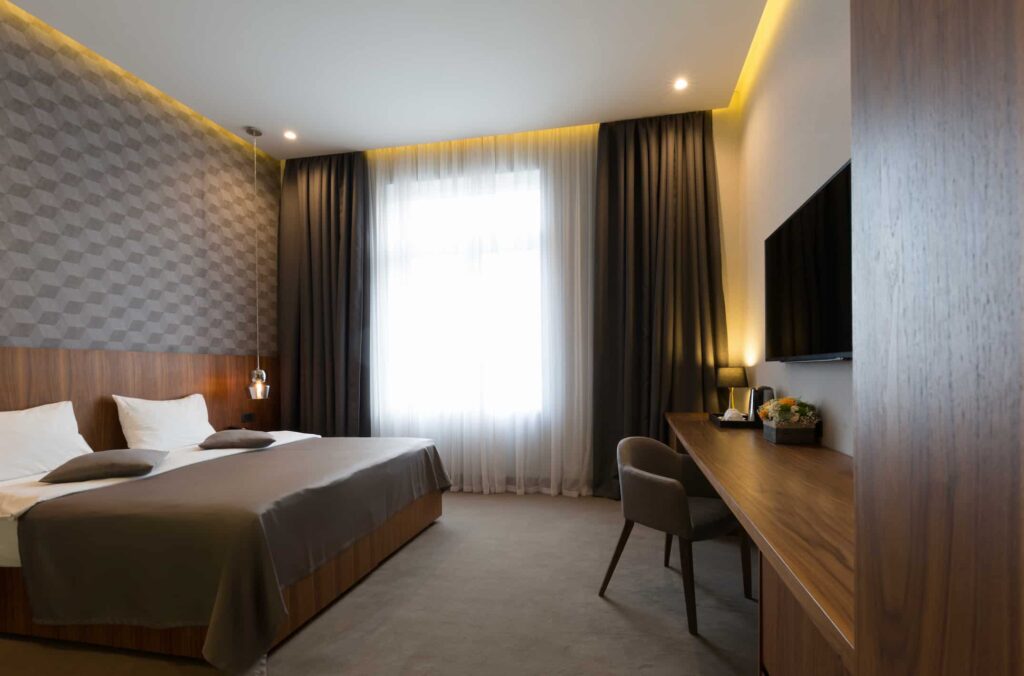
For Turkish hotel contract furniture manufacturers producing at the specification level required for Ghana’s mid-to-upscale hospitality market — MR-MDF substrate, contract-grade hardware, custom dimensions, coordinated finish palettes, export packaging, and documented quality control — a 50-room project represents the minimum scale at which the production setup investment is commercially justified at standard pricing. A 50-room project typically involves 50 sets of guest room casegoods (wardrobe, desk, TV unit, nightstands, headboard, bed base), lobby furniture, restaurant furniture, and outdoor pieces — a production run of several hundred individual items requiring coordinated production across multiple factory departments. Below 50 rooms, the same setup investment is spread across fewer production units, which means either the per-unit price increases to cover setup costs, or the factory declines the project in favour of larger orders that are already in their pipeline.
For Ghana hotel developers planning projects above 50 rooms, MOQ is not a constraint — it is a standard commercial relationship. The manufacturer’s setup investment is justified by the project scale, pricing is competitive, and the factory’s production planning can accommodate the order within a standard timeline. For developers planning projects below 50 rooms, MOQ becomes a genuine planning consideration that affects supplier selection, pricing, and timeline — and requires either a different approach to sourcing or an acceptance of higher per-unit costs.
| Project scale | MOQ status | Relative per-unit cost | Pricing note |
|---|---|---|---|
| Under 50 rooms | Below standard threshold | 15–25% above standard | Setup costs not fully amortised — alternative sourcing model recommended |
| 50–100 rooms | Meets minimum threshold | Standard + 8–15% | Entry-level commercial scale — full production capability available |
| 100–200 rooms | Standard commercial scale | Standard rate | Optimal pricing range — setup fully amortised, production efficient |
| 200+ rooms | Volume scale | Standard − 5–12% | Volume discount territory — production efficiency gains shared with buyer |
The per-unit cost premium for 50 to 100 room projects — typically 8 to 15 percent above the standard 100 to 200 room rate — is not arbitrary margin. It reflects the identical setup investment (technical drawings, sample production, material procurement, production scheduling) spread across fewer units. On a 60-room project with a $90,000 furniture budget, a 10 percent premium represents $9,000 — the total cost of the setup investment that the factory incurs regardless of project size. Developers who understand this pricing structure can negotiate more effectively: the setup cost is fixed, but the timeline, payment terms, and warranty conditions are negotiable.
Hotel furniture minimum order quantity is not uniform across all product categories within a project. Different furniture types carry different production setup requirements, and understanding these differences helps developers plan their procurement more efficiently.
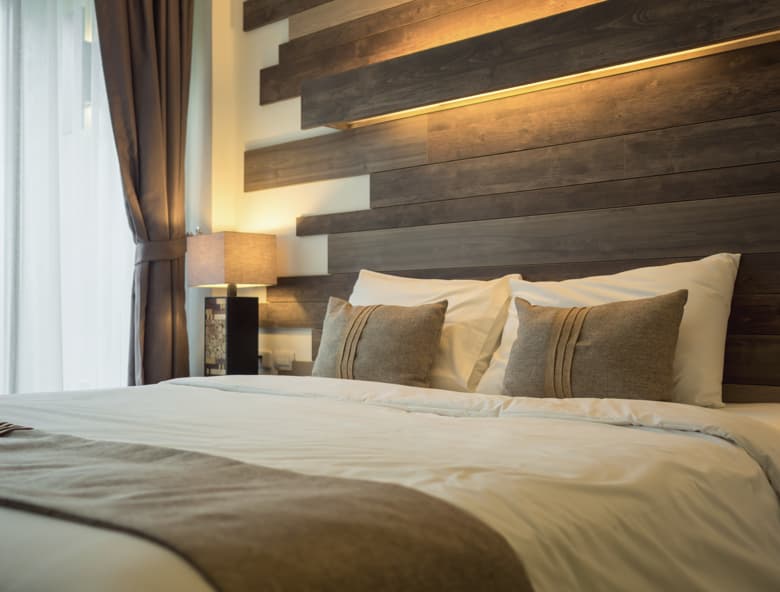
Guest room casegoods — wardrobes, desks, TV units, nightstands — represent the highest-volume category in any hotel furniture order and the category where MOQ considerations are most straightforward. A 50-room project produces 50 sets of each casegood item, which is sufficient to justify custom dimension production from technical drawings at standard pricing. The key MOQ consideration for guest room casegoods is consistency — all 50 wardrobes must match exactly in dimension, finish, and hardware. Production consistency at this scale requires a factory with systematic quality control at the production level, not just at the pre-shipment stage. For how guest room casegoods specification interacts with procurement scale, the hotel guest room furniture specification guide covers the full BOQ requirements that define the production scope.
Upholstered pieces — headboards, lobby seating, restaurant chairs — carry different MOQ dynamics from casegoods because their production involves fabric procurement. Fabric orders from Turkish mills typically carry a minimum quantity of 50 to 100 linear metres per colour and weave specification. A 50-room project using a custom fabric specification for headboards may require a fabric order above the minimum to achieve the specified colour at the required quality level. This fabric MOQ consideration can affect both pricing and timeline — fabric procurement for a custom specification adds 2 to 3 weeks to the production timeline if the fabric must be sourced and delivered to the factory before upholstery production can begin. For how headboard fabric specification interacts with MOQ planning, the hotel headboards supplier guide covers the fabric procurement considerations that affect production timelines.
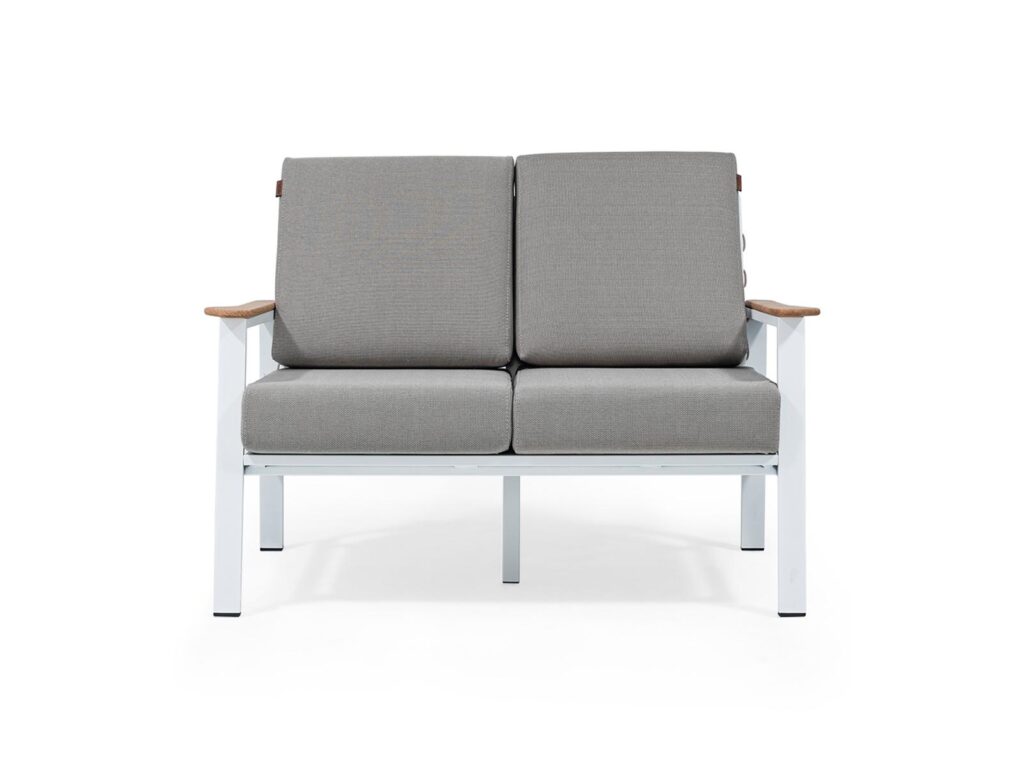
Outdoor furniture — sun loungers, outdoor chairs and tables, poolside seating — is typically a smaller volume category within a hotel project, which means its per-unit MOQ economics are less favourable than guest room casegoods. A 50-room hotel with a pool deck requiring 20 sun loungers and 10 outdoor dining tables does not have sufficient outdoor furniture volume to justify custom production from technical drawings at standard pricing. In practice, outdoor furniture for projects at the 50 to 100 room scale is either sourced from the manufacturer’s standard catalogue of hotel-grade outdoor pieces, or aggregated with the guest room and lobby furniture order to reach a total order value that justifies custom outdoor production. For the complete tropical climate outdoor furniture specification, see the hotel pool outdoor furniture guide.
The most common MOQ-related mistake in Ghana hotel furniture procurement is approaching a contract-grade Turkish manufacturer with a sub-threshold project and negotiating on price without acknowledging the scale constraint. Manufacturers who accept sub-threshold orders at standard pricing typically make adjustments elsewhere — substituting materials, reducing production quality checks, or deprioritising the small order when larger orders create schedule pressure. The sub-threshold premium is not negotiable out of existence; it can only be addressed structurally, by increasing project scale, using catalogue pieces, or phasing procurement. A manufacturer who quotes standard pricing for a 25-room project without discussion of the scale constraint is a manufacturer whose quote assumptions should be scrutinised carefully.
Hotel furniture minimum order quantity affects not just pricing but also production timeline — and the timeline implications of project scale are as important to project planning as the cost implications.
The production timeline for a hotel furniture order consists of two distinct phases: the setup phase (technical drawings, sample production, sample approval, material procurement) and the mass production phase. The setup phase takes approximately the same amount of time regardless of project scale — 4 to 6 weeks for a well-managed project with responsive approvals. For developers using the turkish hotel furniture factory direct sourcing model, the setup phase also includes factory verification — address confirmation, video walkthrough, shop drawing review, and reference checks — which adds 2 to 3 weeks to the pre-production timeline but eliminates the supplier quality risk that makes the investment worthwhile. The mass production phase scales with project scale — a 50-room project takes less production time than a 200-room project. The combined timeline from BOQ submission to production completion runs 8 to 14 weeks for a 50 to 100 room project at standard Turkish contract furniture production pace, and 10 to 16 weeks for a 100 to 200 room project. Adding sea freight (18 to 24 days to Tema Port), customs clearance (5 to 15 days), and inland delivery, the total timeline from BOQ finalisation to furniture on site runs 14 to 18 weeks for a well-managed Ghana hotel furniture project at any scale above 50 rooms.
At the 50-room threshold, a project is commercially viable for a Turkish hotel furniture manufacturer — but it may not be the factory’s highest priority order if larger projects are in the pipeline simultaneously. A 50-room project and a 200-room project both require the same setup investment from the factory, but the 200-room project generates four times the production revenue. Developers placing 50 to 100 room orders with factories also handling 200+ room orders should confirm production scheduling explicitly — not just timeline, but the factory’s commitment to maintaining the 50-room order’s place in the production schedule if a larger order arrives after the BOQ is confirmed. This is a legitimate risk management question to ask before signing a production contract, and a factory that answers it specifically and honestly is demonstrating the operational transparency that protects the developer’s timeline. For how production scheduling interacts with the full procurement timeline, the hotel furniture lead time guide covers the complete sequence from BOQ to installation.
Understanding what is negotiable in a hotel furniture MOQ conversation and what is not prevents wasted negotiation effort and builds more productive supplier relationships.
Several elements of the MOQ commercial relationship are genuinely negotiable for projects at or above the 50-room threshold. Payment terms — the split between deposit, production payment, and balance — can be adjusted based on the developer’s cash flow requirements and the factory’s financial position. Production timeline — factories with available capacity may be willing to accelerate the standard timeline for a project that requires a faster delivery schedule, sometimes in exchange for a timeline premium or early payment commitment. Warranty terms — the duration, scope, and replacement process for furniture that fails in service — are negotiable, and larger projects typically command more comprehensive warranty terms than minimum-threshold projects. Certification documentation requirements — the level of testing and certification documentation required for the specification — can be defined in the contract and become binding once agreed. For how warranty negotiations work in practice with Turkish manufacturers, the hotel furniture warranty turkey guide covers what Turkish manufacturers typically commit to and what they exclude.
The setup cost structure is not negotiable — a manufacturer who agrees to waive the per-unit premium for a sub-threshold project is typically making adjustments elsewhere in the specification or production quality that are not visible in the quotation. The production sequence — technical drawings before samples, samples before mass production, pre-shipment inspection before container loading — is not negotiable as a quality protection mechanism. Compressing the sample approval stage to save time produces the most common and most expensive hotel furniture quality failures. The certification requirements for specified materials — BIFMA, BS 5852, E1, Martindale — cannot be negotiated away without accepting a reduction in specification compliance that the project’s brand standards or financing requirements may not permit. For how certification requirements are built into the procurement contract, the hotel furniture manufacturer certifications turkey guide covers the documentation that should be contractually required before production begins.
The most effective way to handle hotel furniture minimum order quantity for a 50-room project is to approach the procurement with the full project scope defined before contacting manufacturers — complete BOQ across all product categories, confirmed room dimensions, and a clear timeline requirement. A complete brief allows the manufacturer to quote accurately, confirms that the project scope justifies their setup investment, and produces a quotation that can be compared fairly across multiple suppliers. An incomplete brief produces preliminary estimates that change as the scope becomes clear, creating a negotiation dynamic where the developer is always reacting to price revisions rather than comparing defined offers.
The quality of a manufacturer’s MOQ assessment — and the accuracy of the initial quotation that follows it — is determined entirely by the quality of the project brief the developer provides. A manufacturer who receives a complete, detailed project brief can give an accurate MOQ assessment and a reliable quotation within days. A manufacturer who receives a vague enquiry produces a preliminary estimate that changes progressively as the project scope becomes clear, creating a procurement process where the developer is always reacting to revised numbers.
For a Turkish hotel furniture manufacturer to assess whether a project meets their MOQ threshold and quote accurately against it, the brief must include: total room count by room type (standard rooms, superior rooms, junior suites, executive rooms) with a clear indication of whether all room types require the same furniture package or different specifications; a floor plan or layout drawing for each room type showing furniture placement and key dimensions; a material and finish concept — even a rough palette of wood tones, upholstery colours, and surface finishes — that allows the manufacturer to assess material procurement requirements; the project location in Ghana and the target opening date, which determines the production timeline requirement; and a clear statement of any star rating, brand affiliation, or financing requirements that specify certification standards. A brief with these five elements allows a manufacturer to assess MOQ viability, estimate production timeline, and produce a line-item quotation within a week. A brief without them produces a quote that is accurate only for the assumptions the manufacturer makes to fill the gaps.
The most effective MOQ assessment process sends the same complete brief to two or three manufacturers simultaneously — not sequentially after one declines or underquotes. Parallel outreach produces MOQ assessments and quotations on identical specifications, which allows the developer to compare not just price but production capability indicators: which manufacturer asks clarifying questions that demonstrate they have read the brief carefully, which provides a line-item quotation that references the specification, and which responds with a timeline that is specific rather than generic. These response quality differences are more diagnostically valuable than the quoted prices themselves — they reveal which manufacturer is quoting from production experience and which is producing a number to win the enquiry.
Many Ghana hotel developments are planned in phases — an initial opening of 60 to 80 rooms followed by a second phase that adds 40 to 60 more rooms, or a hotel opening followed by a restaurant or spa expansion. Multi-phase projects create MOQ considerations that single-phase projects do not, and planning the procurement strategy across phases before approaching manufacturers produces significantly better outcomes than treating each phase as a separate procurement decision.
The most cost-effective approach to a multi-phase hotel project is to produce furniture for all phases in a single production run — even if the second-phase furniture is not installed until the expansion begins. A single production run eliminates the finish-matching risk that arises when second-phase furniture is ordered from a separate batch, ensures price consistency across phases at the same project scale pricing, and converts what might otherwise be two sub-threshold orders into a single commercially viable scale order. The second-phase furniture is packaged, stored, and delivered to site at the appropriate time. Storage cost at a Accra warehouse typically runs $200 to $400 per container per month — a modest cost relative to the finish-matching and price premium risks of a separate second-phase order.
Separate phase procurement becomes necessary when the development timeline between phases is extended beyond 18 to 24 months — the point at which finish and material batch consistency cannot be guaranteed even from the same manufacturer, because fabric dye lots, HPL batch production, and hardware supplier inventories change within that timeframe. When separate phase procurement is unavoidable, the most important mitigation is specification archiving: confirm with the manufacturer before the first-phase order that they will archive complete production specifications — finish codes, material references, hardware part numbers, technical drawings — for a defined period. A manufacturer who commits to specification archiving for five years provides the developer with the ability to order matched second-phase furniture at any point within that window, without the visual inconsistency that non-archived replacement production creates. For how the complete procurement timeline works across a multi-phase Ghana hotel project, the hotel furniture lead time guide covers the sequencing from brief to installation for each phase.
Several misunderstandings about hotel furniture minimum order quantity consistently create delays and budget surprises in Ghana hotel furniture projects. Recognising these misunderstandings before they affect the procurement process saves weeks and prevents the renegotiation conversations that arise when a developer and manufacturer have different expectations about what the initial quotation covers.
The most common misunderstanding is treating MOQ as a unit price negotiation variable — believing that with enough negotiation, a manufacturer will match standard scale pricing for a sub-threshold project. This misunderstanding produces extended negotiations that delay project timelines without changing the commercial reality: the setup cost is fixed, and below a certain production volume it cannot be fully amortised at standard pricing. Developers who spend three to four weeks negotiating the per-unit price for a 30-room order eventually either accept the premium, move to a catalogue-based specification, or source from a manufacturer whose standard pricing for small orders conceals quality adjustments that become visible at delivery. Recognising the setup cost structure at the start of the procurement process converts these weeks of negotiation into productive specification work.
A related misunderstanding is treating MOQ as a fixed published number rather than a commercial threshold that reflects a specific production economics relationship. Turkish hotel contract furniture manufacturers do not publish MOQ tables. What they have is a minimum viable production scale that reflects their setup investment — and this threshold varies between manufacturers based on their production efficiency, existing pipeline, and geographic market experience. A manufacturer who regularly exports to West Africa has already absorbed the Ghana-specific documentation and logistics setup costs, which means their effective MOQ for a Ghana project may be lower than a manufacturer who has never exported to the region and must develop those systems from scratch for each new market. The most useful MOQ question to ask a Turkish manufacturer is not “what is your minimum order quantity?” but “what is your minimum viable project size for a Ghana hotel order, and what drives that threshold?”
Developers sometimes assume that meeting the overall project MOQ threshold means all product categories within the project are produced at standard pricing. In practice, specific categories within a project — outdoor furniture, banquet chairs, specialised lobby pieces — may have category-level MOQ thresholds that differ from the overall project threshold. A 60-room hotel that meets the overall project MOQ for guest room casegoods may still have an outdoor furniture scope of 20 pieces that falls below the category-level minimum for custom outdoor production. Understanding category-level MOQ thresholds requires asking the manufacturer explicitly about each product category in the BOQ, not assuming that overall project scale covers all categories uniformly. For how banquet and conference furniture procurement works within the context of a full hotel project order, the hotel banquet furniture Ghana guide covers event space furniture specification and procurement at project scale.
Turkish hotel contract furniture manufacturers working at contract specification level for West Africa export typically require a minimum project scale of 50 rooms and above. This threshold reflects the production setup investment — technical drawings, sample production, material procurement, and export documentation — that the factory incurs regardless of project size. Below 50 rooms, per-unit costs increase by 15 to 25 percent to cover setup costs spread across fewer units, or catalogue-based specification may be more appropriate than custom production.
The per-unit pricing structure that reflects MOQ economics is not directly negotiable — a manufacturer who agrees to standard pricing for a sub-threshold project typically makes adjustments elsewhere in specification or quality. What is negotiable for projects at or above the 50-room threshold is payment terms, production timeline, warranty conditions, and certification documentation requirements. These negotiations produce better outcomes than attempting to negotiate the setup cost structure itself.
Per-unit pricing follows a step-function pattern: projects of 50 to 100 rooms carry a premium of 8 to 15 percent above the standard 100 to 200 room rate; projects of 100 to 200 rooms carry standard commercial pricing; projects above 200 rooms qualify for volume discounts of 5 to 12 percent below standard pricing. The differential reflects the setup cost amortisation across different production volumes, not quality differences.
Three options: accept the per-unit premium for custom production; use the manufacturer’s hotel-grade catalogue for standard pieces that do not require custom technical drawings; or use a phased procurement strategy that combines the current project and future expansion furniture in a single production run to reach the 50-room threshold at standard pricing.
Before the hotel opens, confirm with the manufacturer that they archive technical drawings, material references, and finish codes from the original order. Order a small quantity of replacement materials with the original order. Agree on a replacement order protocol — minimum quantities, lead times, and pricing — as part of the original production contract. This converts a future sub-threshold replacement order problem into a pre-agreed commercial arrangement.
WhatsApp us