The hotel nightstand is among the most frequently used pieces of furniture in a guest room — opened, closed, loaded, and reached across dozens of times daily by guests who did not choose it and will not treat it carefully. Despite this, it is consistently among the most under-specified items in Ghana hotel procurement: ordered by external dimensions and finish, without hardware cycle ratings, power integration coordination, or moisture-resistant substrate specification. The result is a piece that looks correct at delivery and shows visible failure within two to three years — loose drawers, swollen edges, delaminating surfaces — while the rest of the room still performs correctly. This guide covers every decision a Ghana hotel developer needs to make when selecting a hotel nightstand supplier for West Africa export — from configuration and dimensions to hardware specification, USB integration, Ghana climate requirements, and supplier verification before production begins. For the complete guest room furniture specification context, covering how nightstand decisions coordinate with headboards, wardrobes, desks, and the full casegoods package, see the hotel guest room furniture specification guide.
Hotel nightstands should be specified with MR-MDF substrate, 2mm ABS edge banding, drawer slides at minimum 50,000 cycles with soft-close mechanism, and a surface finish appropriate for Ghana’s coastal humidity. Power and USB integration must be confirmed with the electrical contractor before the BOQ is written. Standard hotel nightstand dimensions run 500–600mm wide, 400–500mm deep, and 500–550mm high — matching mattress height. The nightstand specification must be coordinated with the headboard mounting height and the bedside lamp position before production begins.

Hotel nightstands are available in several configurations — each with different functional implications, space requirements, and maintenance profiles. The choice between them should be driven by room layout, star category, and operational requirements rather than visual preference alone.
Freestanding nightstands are the most common configuration in three-star and four-star Ghana hotel guest rooms. They stand independently beside the bed, typically include one or two drawers, and are finished on all four sides. The freestanding configuration allows them to be moved for room cleaning — an operational advantage in high-occupancy properties where thorough cleaning between stays is essential. The specification requirement is a fully sealed base — nightstands that touch the floor directly on an unprotected MDF or wood edge will absorb moisture through floor contact in Ghana’s humid conditions. Base protection must be specified: rubber or felt pads at all four contact points prevent both moisture absorption and floor surface damage.
Floating nightstands are fixed to the wall at a defined height, leaving the floor clear beneath them. This configuration is common in boutique and design-led properties where the visual lightness of a wall-mounted unit contributes to the room concept. Operationally, floating nightstands are easier to clean beneath and cannot be moved out of position by guests or housekeeping. The specification requirement is a wall-fixing system appropriate for the wall construction type at the project site — reinforced concrete walls in Ghana hotel construction require different anchor specifications than timber stud framing. The mounting height must be confirmed against the mattress height and bedside lamp position before production begins.
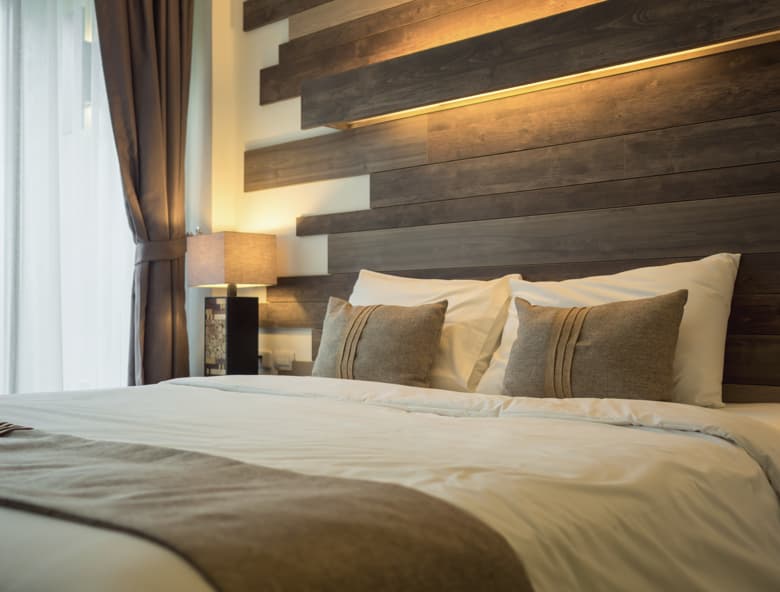
Integrated systems combine the headboard panel and nightstand surfaces into a single wall-mounted unit — sometimes incorporating bedside shelves, reading lights, and power outlets in a continuous architectural element. These systems are the most visually sophisticated and are appropriate for four-star and five-star properties. They are also the most complex to specify — every electrical connection, cable route, and structural fixing must be coordinated with the construction contractor before wall finishes are applied. When a developer is simultaneously working through the hotel headboards supplier selection process and the nightstand specification, integrated systems require both to be resolved as a single coordinated decision rather than two separate BOQ items.
Open shelf nightstands — without drawers, with one or more open shelves — are used in budget and lifestyle hotel concepts where storage simplicity is a design choice. They are easier to produce and lower in cost than drawer configurations, but they offer guests no concealed storage — which may be a brand standard issue for properties with higher security expectations. For the full range of hotel nightstand configurations produced for export projects, see the hotel nightstand manufacturer page.
| Specification element | Minimum requirement | Ghana-specific note |
|---|---|---|
| Carcass substrate | MR-MDF min 18mm | Verify green core on cut edge sample |
| Drawer base | Min 6mm plywood or HDF | Not 3mm hardboard — deflects under load |
| Surface finish | HPL min 0.8mm | Veneer not suitable for coastal properties |
| Edge banding | 2mm ABS, hot-melt applied, radius rounded | Paper or thin PVC delaminates in humidity |
| Drawer slides | Min 50,000 cycles, soft-close | Zinc-plated or stainless steel for coastal use |
| Power integration | Min 1 outlet + USB-A and USB-C | Conduit position confirmed with electrical contractor before wall finish |
| Base protection | Rubber or felt pads at all contact points | Prevents moisture absorption and floor damage |
| Finish coverage | All four sides including back panel | Raw back panels show in rooms where nightstand is not wall-flush |
| Specification element | Minimum requirement | Ghana-specific note |
|---|---|---|
| Carcass substrate | MR-MDF min 18mm | Verify green core on cut edge sample |
| Drawer base | Min 6mm plywood or HDF | Not 3mm hardboard — deflects under load |
| Surface finish | HPL min 0.8mm | Veneer not suitable for coastal properties |
| Edge banding | 2mm ABS, hot-melt applied, radius rounded | Paper or thin PVC delaminates in humidity |
| Drawer slides | Min 50,000 cycles, soft-close | Zinc-plated or stainless steel for coastal use |
| Power integration | Min 1 outlet + USB-A and USB-C | Conduit position confirmed with electrical contractor before wall finish |
| Base protection | Rubber or felt pads at all contact points | Prevents moisture absorption and floor damage |
| Finish coverage | All four sides including back panel | Raw back panels show in rooms where nightstand is not wall-flush |
The most consistently repeated nightstand specification mistake in Ghana hotel procurement is omitting drawer slide cycle count from the BOQ. A BOQ that says “soft-close drawer slides” without a cycle count allows the manufacturer to install slides rated at 15,000 cycles — adequate for residential use, insufficient for hotel occupancy where 5 drawer cycles per day reaches 15,000 cycles in 8 years. Specify minimum 50,000 cycles in the BOQ and request the manufacturer’s slide brand and model number in the sample approval stage. A soft-close slide that cannot be identified by brand and model cannot be verified against a cycle rating.
The most common nightstand hardware failure in Ghana hotel projects is not mechanical — it is the result of moisture-accelerated loosening. In Ghana’s coastal humidity, standard steel drawer slides that are not corrosion-protected show rust at fixing points within 12 to 18 months, which loosens the fixing screw grip and produces drawer misalignment that cannot be corrected without dismantling the nightstand. Specify stainless steel or zinc-plated drawer slides for all nightstands in coastal Ghana properties. The cost premium over standard steel slides is small; the lifespan difference is significant.
Nightstand power integration creates a hard dependency between the furniture production timeline and the construction timeline. The nightstand shop drawing must be shared with the electrical contractor before first-fix electrical work begins — typically 10 to 14 weeks before the planned installation date. If the BOQ is finalised after first-fix electrical work has already been completed, the conduit positions are fixed and may not align with the nightstand grommet positions. This is not a recoverable situation without replastering — it is a permanent visible installation failure that follows every guest who stays in that room.
The nightstand BOQ must be written after the electrical rough-in plan is confirmed, not before. Every nightstand with integrated power requires a conduit position in the wall that must be installed before plastering. Writing the nightstand specification, confirming the power unit position in the shop drawing, sharing the drawing with the electrical contractor, and confirming conduit positions before wall finishes are applied takes two to three coordination steps that cost hours. Discovering that the conduit position does not align with the nightstand grommet after both the wall and the nightstand are finished costs days of remediation work and leaves a visible result regardless.
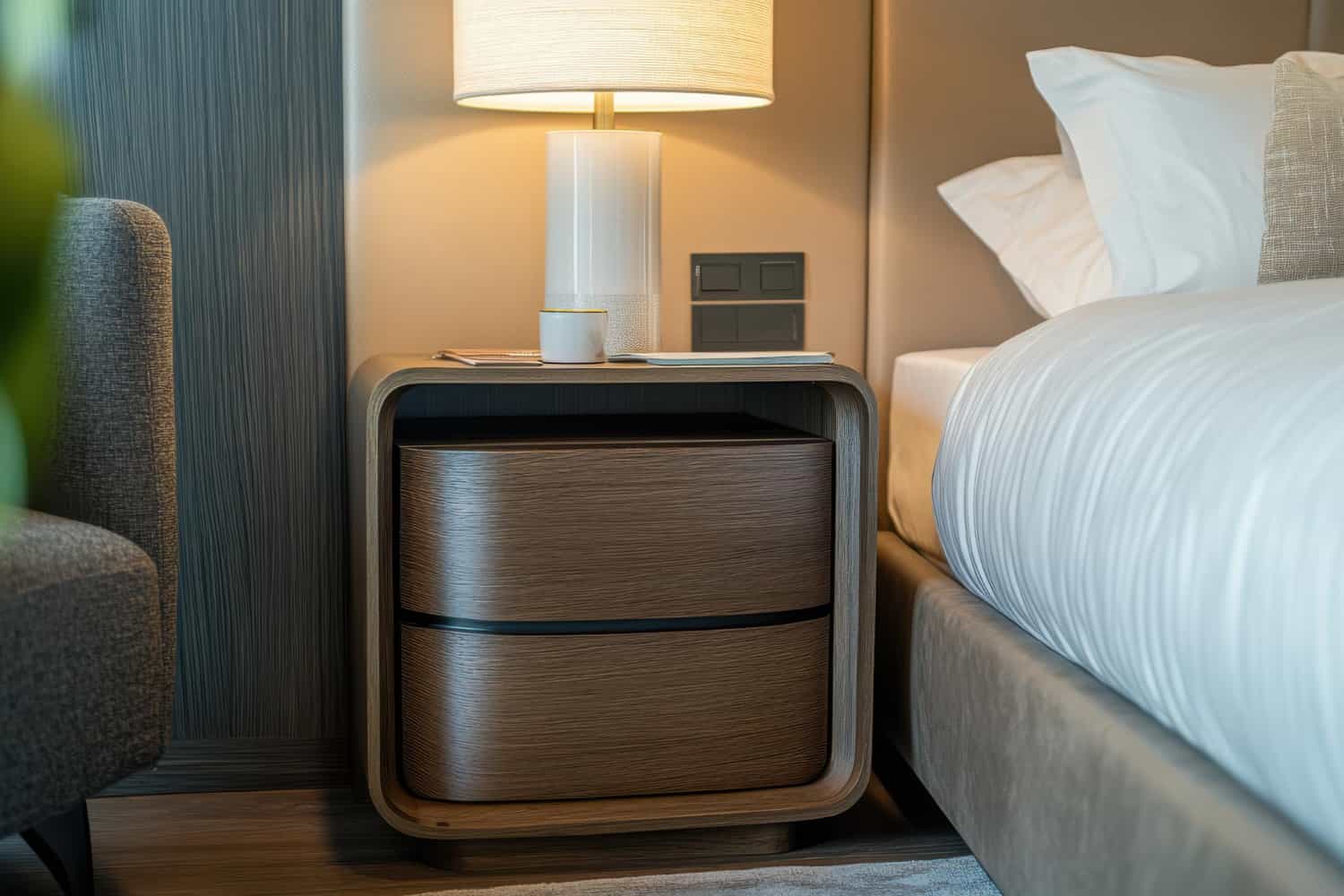
Ghana’s coastal cities maintain relative humidity above 70 percent for most of the year. At this level, veneer surfaces on nightstand top panels show moisture staining and edge lifting within 12 to 18 months — particularly around the top surface perimeter where water from glasses pools overnight. HPL at minimum 0.8mm on MR-MDF substrate is not a premium specification for Ghana coastal hotel nightstands. It is the baseline that determines whether the piece looks correct at year three or requires replacement before year two.
The nightstand is part of a coordinated furniture system that includes the headboard, bed base, bedside lamp, wardrobe, and desk. Specification decisions for each affect the nightstand specification, and vice versa.
The nightstand height must be confirmed against the headboard mounting height before production begins for either piece. In rooms with wall-mounted headboard panels, the bottom edge of the headboard should sit at approximately nightstand surface level or slightly above it. A headboard panel mounted 200mm above the nightstand top surface creates a visual gap that looks poorly designed regardless of individual piece quality. The bedside lamp base must also fit the nightstand top surface with space remaining for guest use — a 200mm diameter lamp base on a 500mm wide nightstand occupies 40 percent of the surface width. Confirm lamp base dimensions against the nightstand surface dimensions before ordering either piece.
The nightstand finish must coordinate with the wardrobe, desk, and TV unit finishes in the same room. All guest room casegoods should be produced in a single coordinated production run from the same manufacturer. A nightstand produced in a different batch from the wardrobe, even using the same HPL reference, may show a slight colour variation visible under the same lighting. The finish palette decision is a design decision that must be made before it becomes a production decision. The public area furniture — lobby seating, conference chairs — operates under a different finish logic from guest room casegoods, but for properties where the guest room aesthetic extends into public spaces, the hotel lobby furniture guide and the hotel banquet furniture Ghana guide cover the specification requirements for those zones separately from the guest room package.
Turkish hotel nightstand manufacturers produce for Ghana hotel projects regularly — and the quality and specification compliance range between suppliers is wide. A nightstand that appears identical in a product photograph can vary enormously in substrate quality, hardware grade, edge banding thickness, and moisture resistance.
When briefing a Turkish hotel nightstand supplier for a Ghana project, the specification document must include: external dimensions; number of drawers and internal drawer dimensions; substrate specification including drawer bottom material; surface finish with RAL or NCS colour reference; edge banding material, thickness, and application method; drawer slide specification including cycle count, soft-close, and corrosion protection; power integration details including outlet type, USB port types, position, and cable routing grommet position; and finish on all four visible sides.
Sample verification before production release requires: checking MR-MDF green core on a cut edge sample; measuring edge banding thickness with a calliper; testing drawer slide operation at least 20 times consecutively to verify soft-close function and alignment; confirming power unit operation with a test device; and checking surface finish under raking light. According to Hospitality Net’s hotel FF&E procurement guidance, sample approval is the most effective single quality control intervention in hotel furniture procurement — and the one most frequently compressed under schedule pressure. For the complete supplier evaluation framework, see the hotel furniture suppliers Turkey guide. For outdoor and poolside furniture specification covering pool deck and sun lounger requirements in Ghana’s tropical climate — which operates under completely different material logic from guest room casegoods — the hotel pool outdoor furniture guide covers those decisions separately.
Nightstand specification should be calibrated to the property’s star category — not because lower-category hotels deserve lower-quality nightstands, but because the specification elements that justify cost investment vary between categories.
Budget and three-star hotels require nightstands that perform reliably under high occupancy and fast room turnover. The priority is structural durability — MR-MDF substrate, 2mm ABS edge banding, corrosion-protected drawer slides at 50,000 cycles, soft-close mechanism. A single drawer with a cleanable HPL surface in a neutral colour and a standard power outlet is the correct specification at this category.
Four-star hotels justify investment in design detail alongside durability. A four-star nightstand might include two drawers with full-extension soft-close slides, USB-C charging integrated into a recessed panel, and a surface material that coordinates with the headboard and wardrobe as a designed ensemble. At four-star level, guests notice the coordination between furniture pieces and mention it positively in reviews.
Five-star and boutique hotels require nightstand specifications that function as part of a designed bed wall concept — often integrated with the headboard panel, incorporating concealed cable management and custom surface materials. The nightstand is not specified independently at this category — it is designed as part of a coordinated furniture system, with every dimension, surface, and hardware element confirmed against adjacent pieces before technical drawings are produced.
The specification mistakes that produce nightstand failures in Ghana hotel projects recur across property types and star categories — not because developers are careless, but because the specification decisions that matter most are invisible at the point of procurement. A correctly specified nightstand and an incorrectly specified one look identical at delivery. The difference appears during operation.
Specifying standard MDF instead of MR-MDF is the most common and most consequential substrate error for Ghana projects. The verification is simple: request a cut edge sample and check for the green core that confirms MR-MDF. A supplier who cannot provide a cut edge sample for verification is not confirming their substrate specification. Selecting HPL that is below 0.8mm thickness is a related error — thinner HPL shows print-through from the substrate surface texture within months of hotel use, creating a visible surface quality failure that develops gradually and is difficult to attribute until it is widespread across multiple rooms.
Omitting drawer slide cycle count from the BOQ leaves the hardware decision to the manufacturer’s cost preference. A BOQ that specifies “quality drawer slides” without a cycle count and corrosion protection requirement is a BOQ that will receive whatever the manufacturer’s standard hardware is — typically below 30,000 cycles in standard steel, which reaches its rated count within 3 to 5 years of hotel occupancy. Specifying power integration without electrical contractor coordination is equally common — a nightstand with integrated power specified in the BOQ but not coordinated with the electrical rough-in plan produces a conduit-grommet mismatch that is only discovered at installation, after both wall and nightstand are finished. Ordering nightstands before confirming mattress height is the final common error — a nightstand ordered at 500mm height for a mattress at 650mm height produces a surface 150mm below the mattress top, which is functionally inconvenient and visually awkward. For the complete pre-shipment inspection framework that catches specification errors before furniture leaves the factory, see the hotel furniture quality checklist guide.
Hotel nightstand packaging for sea freight from Turkey to Ghana requires specific consideration because nightstand surfaces — HPL tops, veneer panels, lacquered edges — are among the most vulnerable to transit damage of all guest room furniture categories. A wardrobe carcass panel can absorb minor packaging contact without visible damage. A nightstand top surface with a glass-smooth HPL finish shows a contact mark from inadequate inter-carton padding as clearly as a scratch from a sharp tool.
Correct packaging for hotel nightstands covers: individual polyethylene film wrapping for every piece before carton packaging — the poly wrap provides a moisture barrier and a surface-contact buffer; corner protectors at all four top corners where the HPL edge meets the vertical panel — the most impact-vulnerable points on a nightstand during handling; foam pad between the drawer face and the carton wall to prevent the drawer face from contacting the carton under vibration during the Turkey-to-Tema sea transit; and a carton stack rating that supports the weight of nightstand cartons stacked above it in the container without transferring load to the nightstand body.
Nightstands are typically among the lighter and more surface-sensitive items in a hotel furniture container. The correct loading position is above heavier items — wardrobes, bed bases — never below them. A nightstand carton under a wardrobe carton in a container that experiences normal sea freight vibration will show surface compression marks at the points where the heavier carton contacts the nightstand through the packaging. This is a loading error, not a manufacturing defect, and is not covered by manufacturer warranty. Delivery day coordination for nightstands requires site rooms to be fully finished — floors laid, walls painted, electrical rough-in complete — before nightstands are installed. A nightstand stored in a finished carton on a dusty construction site for two weeks before installation may arrive at the installation date with surface contamination requiring cleaning before the room can be photographed. For how container loading sequence and packaging work together for the full Turkey-to-Ghana hotel furniture shipment, see the hotel furniture container loading guide.
Standard hotel nightstand height runs 500 to 550mm — designed to sit level with or slightly below the top of the mattress, which is typically 550 to 650mm from the floor depending on bed base and mattress thickness. The nightstand height must be confirmed against the specific mattress height for the project rather than assumed from a standard dimension. A nightstand that is significantly below mattress height is functionally inconvenient for guests reaching items from a lying position.
Hotel nightstand drawer slides should be specified at minimum 50,000 cycles with a soft-close mechanism. For coastal Ghana properties, specify stainless steel or zinc-plated slides rather than standard steel to prevent corrosion-accelerated loosening in high-humidity conditions. The cycle count specification must appear in the BOQ — a verbal quality claim from the manufacturer is not a verifiable specification.
For three-star and above Ghana hotel properties — particularly those targeting business travellers in Accra — USB charging ports in nightstands are expected by guests and mentioned positively in reviews when present and negatively when absent. The specification must include USB-C ports alongside USB-A to accommodate current-generation devices. Confirm port position and cable routing with the electrical contractor before the BOQ is written.
HPL (high-pressure laminate) at minimum 0.8mm thickness on MR-MDF substrate is the correct specification for hotel nightstands in Ghana. Veneer surfaces on nightstands in coastal Ghana properties show moisture staining and edge lifting within 12 to 18 months. HPL resists moisture contact, cleaning chemical exposure, and daily use impacts significantly better than veneer in the nightstand application.
Confirm the nightstand height and the headboard mounting height from the same reference point — finished floor level — before production begins for either piece. The bottom edge of the wall-mounted headboard panel should sit at approximately the nightstand top surface height or slightly above it, to avoid a visually uncomfortable gap between the two pieces. Confirm the bedside lamp base dimensions against the nightstand top surface area before ordering either piece.
Hotel nightstands follow the standard hotel furniture lead time: 14 to 18 weeks from BOQ finalisation to installation on site. Nightstands with power integration require electrical rough-in coordination that must happen before wall finishes are applied — which means the nightstand specification must be confirmed and the shop drawing shared with the electrical contractor at least 6 to 8 weeks before wall finishes are scheduled.
WhatsApp us