Hotel writing desk specification must define surface dimensions (minimum 1200mm wide, 550mm deep), surface material (HPL at minimum 0.8mm for Ghana coastal properties), power and USB integration with electrical contractor coordination, cable management method, substrate (MR-MDF throughout), desk height (740–760mm), and finish coordination with adjacent casegoods. A desk specified only by external dimensions and finish is not a specification — it is an incomplete brief that leaves power integration, cable routing, and surface material decisions to the manufacturer’s cost preference.
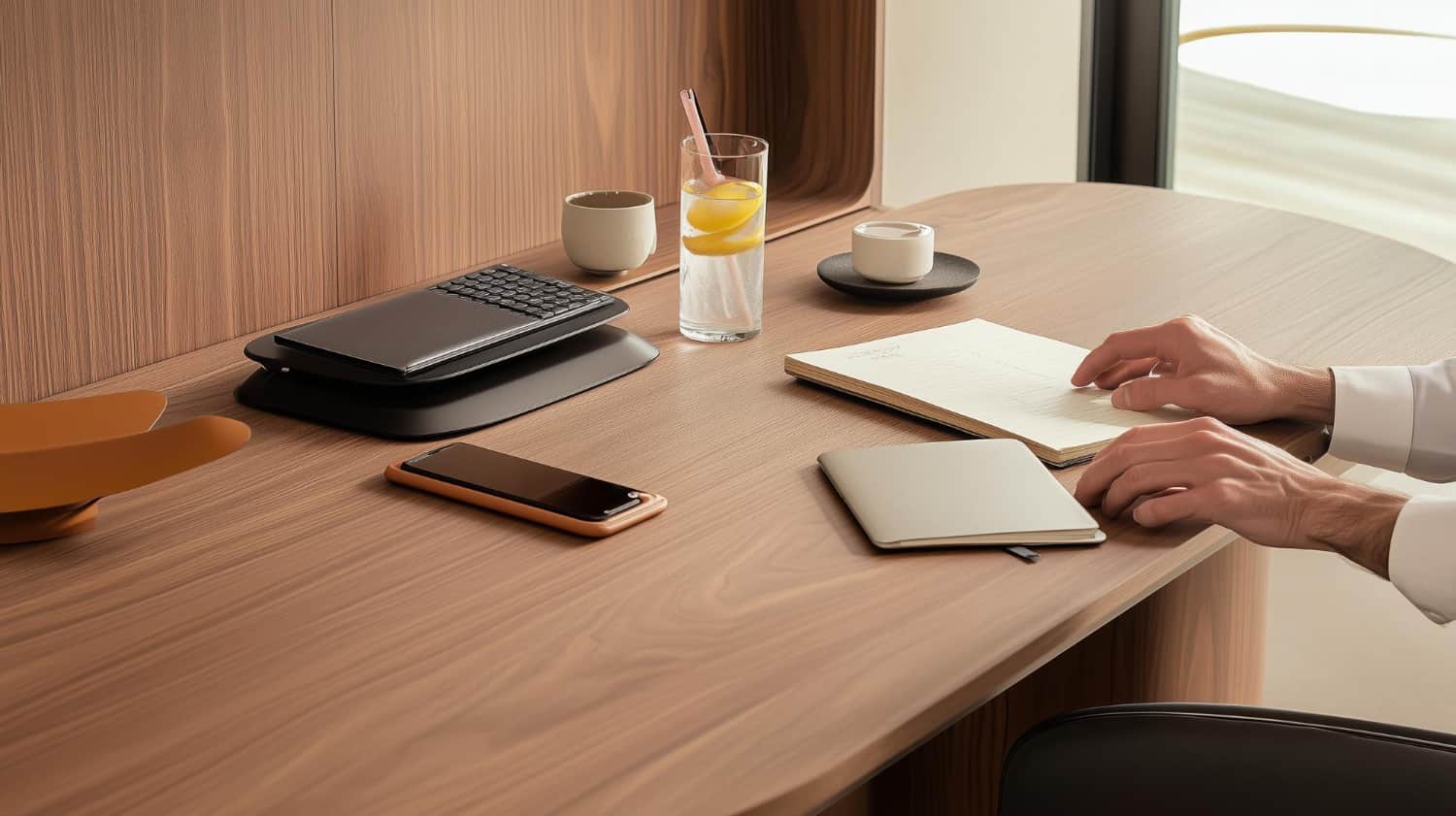
Hotel writing desks are available in several configurations — each with different functional implications, spatial requirements, and specification complexity. The choice between them should be driven by room layout, star category, and the guest profile the hotel serves rather than visual preference alone.
The standard freestanding desk is the most common configuration in three-star and four-star Ghana hotel guest rooms. It stands independently against the wall, typically includes one or two drawers for guest storage, and is finished on all four sides. The specification requirement is a back panel with a defined cable exit point — a freestanding desk without a planned cable grommet produces visible surface-mounted cabling that is difficult to conceal after installation. Standard freestanding desks run 1200 to 1600mm wide and 550 to 600mm deep, providing adequate working surface for a laptop, notebook, and accessories simultaneously.
Wall-mounted desks are fixed to the wall at a defined height, leaving the floor clear beneath them. This configuration is common in boutique and lifestyle hotels where the visual lightness of a floating desk contributes to the room concept. The specification requirement is a wall-fixing system appropriate for the wall construction type at the project site — reinforced concrete walls in Ghana hotel construction require different anchor specifications than timber stud framing. Wall-mounted desks also require careful cable planning: power conduits must be installed in the wall at positions that align with the desk’s power unit before wall finishes are applied.
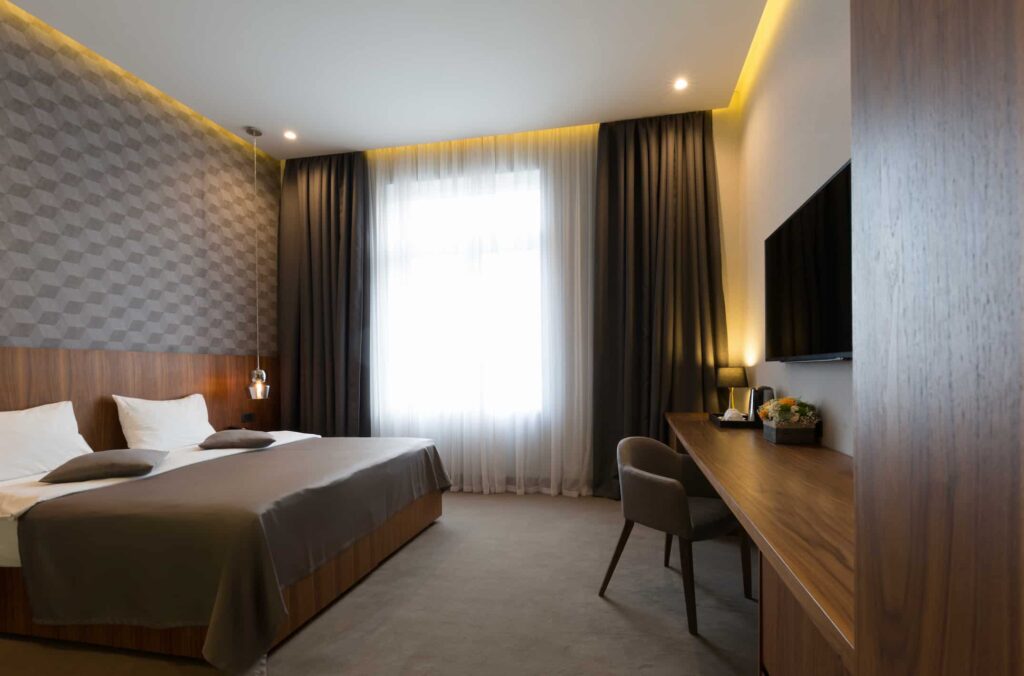
Integrated configurations combine the desk surface with a storage unit — shelving, drawers, or a combination — in a single casegoods piece. These configurations are common in four-star and five-star rooms where the desk is part of a designed furniture wall concept. Specification complexity is higher: every storage element must be individually defined in the BOQ, and the integrated unit’s electrical and cable routing requirements must be coordinated with the construction contractor before the wall behind it is finished. The wardrobe in the same room often uses the same finish palette as the desk — the hotel wardrobe specification guide covers how finish coordination between these two pieces works before production begins.
Corner desks use the room corner to maximise surface area — wrapping around two walls to provide a larger working surface than a single-wall configuration allows. They are appropriate for extended-stay properties, apartment hotels, and suites where guests spend extended time working in the room. Corner desks are dimensionally complex: the corner joint, depth on each wall, and the position of the corner itself must all be confirmed against the room’s exact corner geometry before production. A corner desk produced to standard dimensions for a room with non-standard corner geometry is a production error that cannot be corrected on site.
v
Internal layout specification is where the majority of wardrobe BOQs in Ghana hotel projects are incomplete — not because developers are careless, but because internal layout looks like a detail that the manufacturer will figure out, when in practice it is a series of decisions that directly determine whether the wardrobe functions correctly for hotel guests.
The hanging rail section requires definition of: rail length (typically 800 to 1000mm for a single bay), rail height from the wardrobe floor (typically 1600 to 1800mm for full-length hanging, 900 to 1000mm for short-hang configurations that allow a shelf below), rail material and diameter (25mm chrome-plated steel is the standard hotel specification — thinner rails bend under loaded hangers within the first year), and whether the configuration is full-length hang, double-hang, or a combination. A double-hang configuration — two rails at half the standard height, one above the other — doubles the hanging capacity in the same horizontal space but requires that guests use it for shirts and jackets rather than full-length garments. This is a conscious operational decision that affects the wardrobe’s function for guests and must be specified, not assumed.
Every shelf position must be specified by height from the wardrobe floor and by shelf depth. A wardrobe with a “shelf above the hanging rail” specified in the BOQ but without a defined height allows the manufacturer to position the shelf at whatever height suits their standard production template — which may not align with the headroom a guest needs to access the shelf comfortably. A safe housing — the recessed or surface-mounted space for a room safe — must be specified with exact dimensions matching the safe model selected for the property, and its position must allow a guest to operate the safe from a standing or kneeling position without removing items stored on adjacent shelves. A luggage shelf — the horizontal surface at low level for placing an open suitcase — must be specified at a height that allows a standard suitcase to open without contacting the shelf above it: minimum 500 to 550mm clear height between the luggage shelf surface and the shelf above.
Hotel writing desks in Ghana coastal properties face a surface stress combination that no other guest room casegood shares: direct laptop contact, hot beverage condensation, cleaning chemical exposure, and ambient humidity — simultaneously, every day. HPL at minimum 0.8mm is the only surface specification that resists all four of these stress factors without requiring specialist maintenance. Veneer desk surfaces in Accra coastal properties that are not sealed with a closed-pore lacquer system show moisture ring staining from beverage glasses within the first operating month — not the first year. Once the staining appears it cannot be removed without refinishing the surface.
| Surface material | Scratch resistance | Moisture resistance | Recommended category |
|---|---|---|---|
| HPL min 0.8mm | Excellent | Excellent | 3-star and above, all locations |
| Veneer + closed-pore lacquer | Good if hardness-rated | Good if correctly sealed | 4-star and above |
| Lacquered MDF 3+ coats | Adequate | Good with UV topcoat | 3-star and above |
| Lacquered MDF 2 coats | Poor — scratches visible within 12 months | Adequate | Budget only |
| Veneer + open-pore finish | Poor | Poor — not for coastal Ghana | Not recommended |
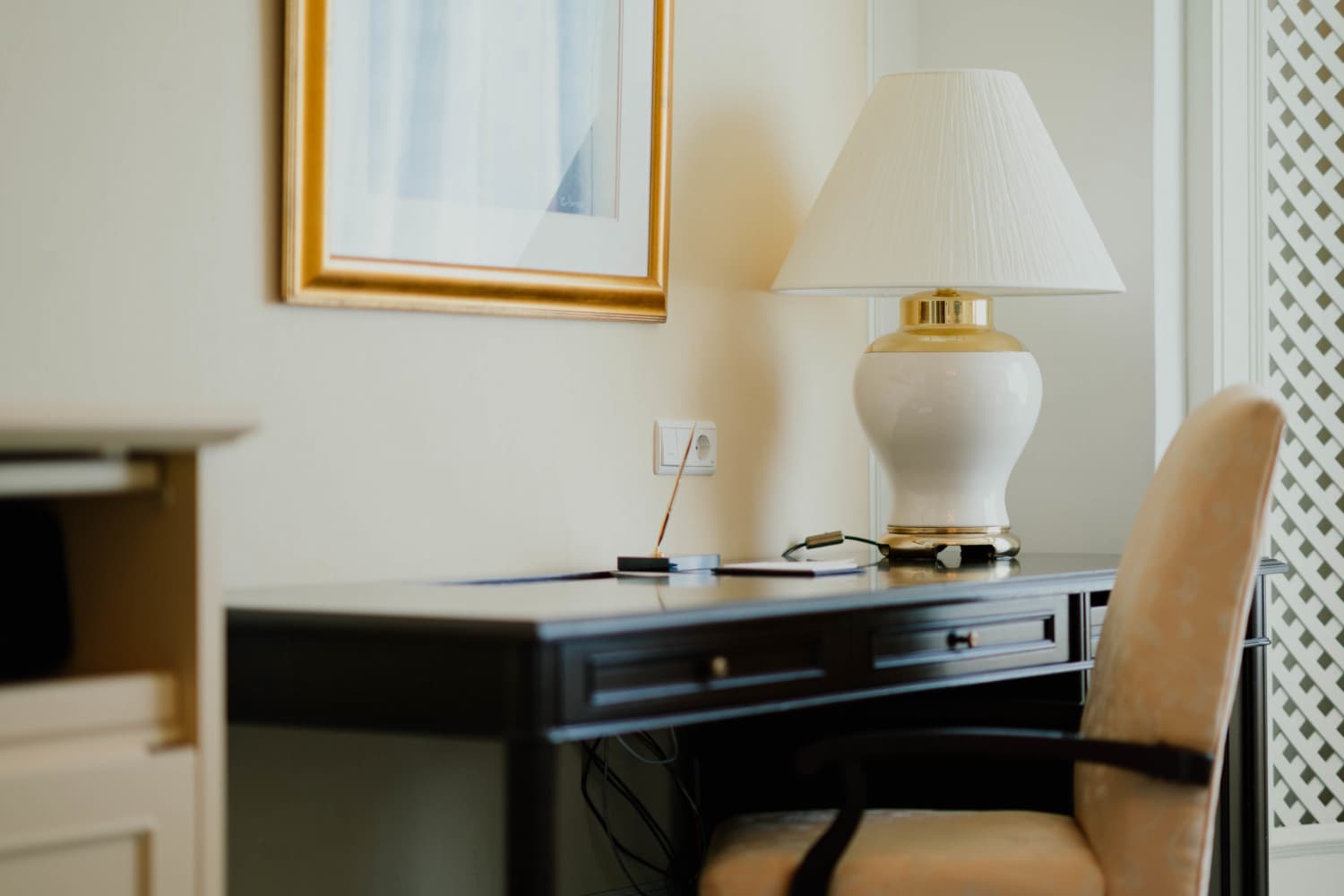
The desk shop drawing showing the power unit position and back panel cable exit grommet must be shared with the electrical contractor before first-fix electrical work begins — typically 10 to 14 weeks before the planned desk installation date. In Ghana hotel construction where electrical rough-in and furniture procurement run in parallel rather than sequentially, this coordination step requires the desk BOQ to be written and the shop drawing produced before the electrical contractor begins first-fix work on the floor. A desk BOQ written after first-fix electrical work is complete is a desk BOQ written too late — the conduit positions are fixed and may not align with the desk grommet.
The most common hotel writing desk specification failure in Ghana hotel projects is power integration without electrical coordination. A desk with integrated power specified in the BOQ but not coordinated with the electrical contractor’s rough-in plan produces a conduit-grommet mismatch that is only discovered at installation — after both the wall and the desk are finished. Correcting this mismatch requires either surface-mounted cable trunking visible to every guest, or replastering the wall section behind the desk, reinstalling the conduit, and refinishing the wall. Both corrections are expensive and take time in an operating hotel. The prevention is a single coordination step taken before wall finishes are applied: share the desk shop drawing with the electrical contractor and confirm conduit position alignment.
The most common cable management mistake in Ghana hotel desk procurement is specifying a surface grommet without defining the cable channel routing from the grommet to the back panel exit. A grommet in the desk surface with no internal channel produces a visible cable loop inside the desk body — visible every time a guest opens a drawer and looks down. The cable management specification must define the complete route: surface grommet position, internal channel dimensions, and back panel exit grommet position. A desk with a surface grommet and no internal channel is not a cable-managed desk. It is a desk with a hole in it.
Hotel desk height and desk chair height must be specified in coordination — not independently. This is the most frequently made ergonomic specification error in hotel guest room furniture procurement: the desk is specified at standard height, the chair is selected by appearance, and the ergonomic relationship between them is never checked. The result is a work setup that is uncomfortable for the majority of guests who use it, generating reviews that describe the desk as “too high” or the chair as “too low” — which are both symptoms of a coordination failure, not individual product quality failures.
Standard hotel desk height is 740 to 760mm from the finished floor level — the international hospitality convention for work desk height. The desk chair must provide a seat height that allows a typical adult to sit with feet flat on the floor and forearms at approximately desk surface level — for a 740 to 760mm desk, the correct seat height is 420 to 460mm for a non-adjustable chair. A desk chair with a fixed seat height of 500mm at a 750mm desk creates an uncomfortable posture for most adult guests. A desk chair with a fixed seat height of 400mm at the same desk requires the guest to reach upward to use the desk surface — equally uncomfortable. Confirm the specific chair seat height against the specific desk height before either piece goes into production.
Desk chair castors must be specified for the floor finish used in the room — hard floor castors for tile or polished concrete, carpet castors for carpeted rooms. The wrong castor type on the wrong floor surface creates both a guest experience failure and accelerated floor damage. Hard floor castors on tile are smooth-rolling and protect the tile surface. Standard carpet castors on tile roll poorly, scratch the tile finish, and make noise when the chair is moved. Most Ghana hotel guest rooms use tile or polished concrete flooring — hard floor castors are the correct default specification for Ghana. Request castor type confirmation in the desk chair BOQ and verify it in the sample before production is released.
Hotel writing desk substrate specification for Ghana follows the same climate logic as all guest room casegoods — MR-MDF throughout, 2mm ABS edge banding, and a finish system appropriate for coastal humidity. The desk has one specific structural requirement that distinguishes it from other casegoods: its surface must support the concentrated load of a laptop at the same position, day after day, without showing sag or surface compression.
Desk carcass panels must be MR-MDF at minimum 18mm thickness throughout. The desk top panel — the working surface — must be supported at the back by the carcass structure and at the front by either a drawer unit or a support panel that prevents the surface from deflecting under load. A desk top panel spanning 1200 to 1600mm without intermediate support and supported only at the back and sides will show visible sag at the centre within 2 to 3 years of hotel use. Include a support panel or centre support leg in the desk BOQ specification if the configuration spans more than 1000mm without intermediate structural support.
2mm ABS edge banding on all exposed panel edges — including the desk top front edge and side edges — is the minimum specification for Ghana hotel desk carcass panels. The desk top front edge is at hand height and receives direct contact from guests who lean against it — this edge must be both moisture-resistant and smooth-rounded to prevent the sharp edge feel that thin or poorly applied banding creates. Carcass joint method must be defined in the BOQ: dowel and glue is the standard hotel casegoods specification; cam-lock assembly (flat-pack construction) produces weaker joints that loosen under the vibration of daily use in hotel rooms where guests consistently push and pull the desk from the wall for cleaning access.
The desk specification must be finalised before the electrical rough-in plan is confirmed, and the electrical rough-in plan must be confirmed before wall finishes are applied. This three-stage sequence — desk spec, then conduit position, then wall finish — must be managed as a coordinated workflow, not as three separate project activities managed by three separate contractors. In Ghana hotel projects where construction and furniture procurement timelines run in parallel, this coordination point is where the most avoidable installation problems originate. A single coordination meeting between the furniture manufacturer and the electrical contractor, before wall plastering begins, prevents the most common and most expensive desk installation failures.
Turkish hotel writing desk manufacturers produce for Ghana hotel projects as part of the broader guest room casegoods package — the desk is typically produced in the same production run as the wardrobe, TV unit, and nightstands, using the same finish palette and substrate specification throughout.
When briefing a Turkish hotel desk manufacturer for a Ghana project, the specification must include: external dimensions (width, depth, height); number of drawers and internal dimensions; substrate specification — MR-MDF at defined thickness throughout, including intermediate support panel if required; surface finish with scratch resistance grade and colour reference; edge banding material and thickness; power integration — outlet type and count, USB port type and count, position, and cable routing grommet position with electrical contractor conduit position confirmed; back panel finish specification; desk height confirmed against chair seat height; and packaging requirements for sea freight. A desk BOQ that defines only dimensions and finish leaves power integration, cable management, and surface scratch resistance undefined — the three elements most directly connected to guest satisfaction.
Sample verification for hotel writing desks covers: surface scratch resistance — drag a laptop across the sample surface at normal pressure and check for visible scratching; moisture resistance — place a wet glass on the sample surface for 30 minutes and check for ring marking; power unit function — connect a test device to every outlet and USB port; cable management — route a test cable through the grommet and back panel exit to confirm the routing is clean and requires no surface-mounted management; edge banding thickness measured with a calliper to verify 2mm specification. According to Hospitality Net’s hotel FF&E procurement analysis, desk surface quality — particularly scratch resistance and power integration — is among the most frequently cited specification non-compliance issues at pre-shipment inspection. For the complete supplier verification framework, see the hotel furniture suppliers Turkey guide.
The writing desk must be specified and produced in coordination with every other casegoods item in the guest room — not independently. Finish inconsistency, dimensional conflicts, and production run variations between the desk and adjacent pieces are the most common coordination failures in Ghana hotel furniture projects.
The desk surface finish must coordinate with the wardrobe, nightstand, and TV unit finishes in the same room. All guest room casegoods should be produced in a single coordinated production run from the same manufacturer, using HPL or veneer from the same batch, to guarantee colour and texture consistency. A desk produced in a different batch from the wardrobe, even using the same HPL reference code, may show a perceptible colour variation under the room’s lighting — a quality inconsistency that guests notice and photograph. The finish palette decision is a design decision that must be made before any individual piece is specified in isolation.
The desk position in the room layout must be confirmed against three adjacent elements before production: the window position (desk adjacent to a window requires UV-resistant surface topcoat if veneer is specified); the wardrobe door swing (a hinged wardrobe door that opens toward the desk position creates a clearance conflict if the desk is positioned too close); and the bed access corridor (the desk must not reduce the bed access corridor below minimum functional width). The lobby furniture in public areas and the banquet furniture in event spaces operate under completely different specification logic from guest room casegoods — the hotel lobby furniture guide and the hotel banquet furniture Ghana guide cover those categories separately. For outdoor and poolside furniture that completes the full hotel furniture scope, see the hotel pool outdoor furniture guide.
Standard hotel writing desk height is 740 to 760mm from finished floor level — the international hospitality convention for work desk height. The desk chair seat height must be confirmed against this desk height before either piece goes into production. A desk chair with a seat height that does not correspond to the desk surface height creates an ergonomic failure that cannot be corrected without replacing one or both pieces.
A functional hotel writing desk requires minimum 1200mm width and 550mm depth. These dimensions accommodate a laptop, notebook, beverage, and phone charger simultaneously — the items a business guest uses at the same time. Desks specified below 1200mm width consistently generate negative reviews from business travellers who cannot use their devices and accessories simultaneously.
HPL (high-pressure laminate) at minimum 0.8mm thickness with a defined scratch resistance grade is the highest-performing surface for hotel writing desks in Ghana’s coastal conditions. HPL resists laptop rubber foot abrasion, cleaning chemical exposure, and moisture contact better than veneer or lacquered MDF in the desk application. Veneer is appropriate for four-star and above properties if specified with a closed-pore lacquer system and a hardness-rated topcoat suitable for worksurface use.
The desk shop drawing showing the power unit position and the back panel cable exit grommet must be shared with the electrical contractor before first-fix electrical work begins — before wall plastering. The electrical contractor installs the conduit at the position that aligns with the desk grommet, wall finishes are applied, and the desk is installed with the cable routed through the pre-installed conduit. Any variation in this sequence produces a visible cable management failure that cannot be corrected without replastering or accepting surface-mounted cabling.
MR-MDF (moisture-resistant MDF) at minimum 18mm thickness throughout — including all internal panels. Verify MR-MDF compliance by requesting a cut edge sample and checking for green core (cream core indicates standard MDF). The desk top panel must be supported at the centre for spans above 1000mm to prevent surface sag under repeated laptop load.
Hotel writing desks from Turkish manufacturers to Ghana follow the standard hotel furniture lead time: 14 to 18 weeks from BOQ finalisation to installation on site. As part of the guest room casegoods package, desks are produced in the same production run as wardrobes and nightstands — the BOQ for all casegoods must be finalised simultaneously, and the electrical coordination for the desk must be completed before the production timeline begins.
WhatsApp us